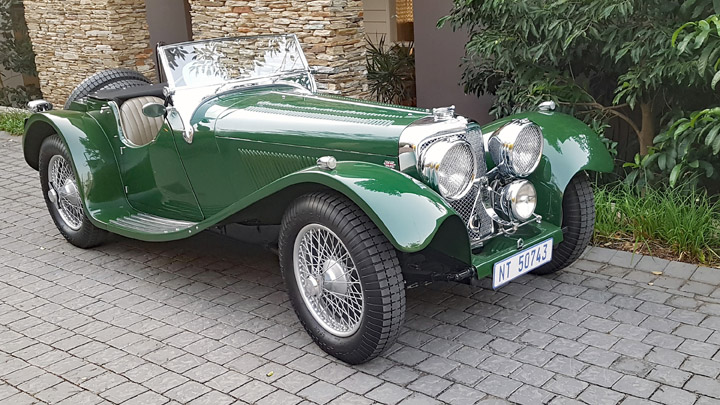
Moss Green Dream Machine: SS100 Jaguar, 2½-litre, Open Tourer Reproduction
Visible authenticity
Pics supplied
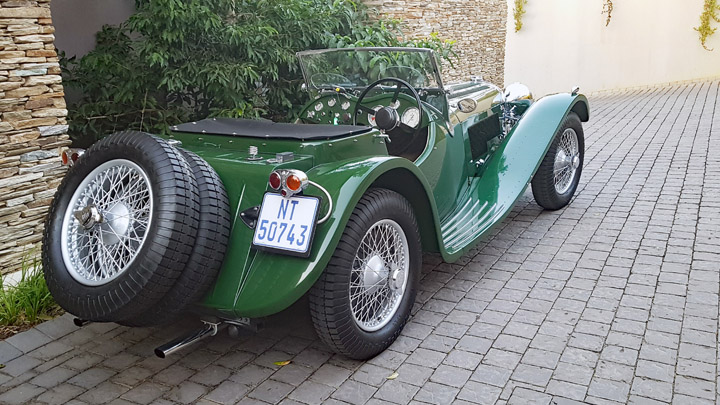
Ballito resident Peter Micklewright’s handsome, Moss Green, SS100 Jaguar Open Tourer isn’t a Replica. It’s a Reproduction.
The first would be an exact, or nearly-so, duplication of an interesting old car. Modern materials and technology could, if necessary, be used in its construction. A Reproduction is a remake of an interesting old car; primarily using original components but allowing for worn, broken or missing items to be carefully recreated using, as far as possible, period-spec materials.
Peter’s car began life as a 2½-litre saloon. He has the Jaguar Heritage Trust certificate to confirm that. But, although closed-top models are nice enough, SS100 Open Tourers are far and away sexier.
Background: In 1936 SS Cars produced this advanced and remarkable model at a fraction of the cost of similar high-powered sports cars available at the time. The 2½ litre SS100, presented by William Lyons in 1936, had both outstanding styling and remarkable performance. Even a completely standard example could comfortably keep up with today’s fast traffic.
Its name, SS100 Jaguar, indicated that it was “as lithe as a jungle cat” and could reach a (claimed) top speed of 100 miles per hour. Original 2½ litre SS100s, with a volumetric displacement of 2.664cc and a final drive ratio of 4:1, had very high torque and were mostly driven in fourth and third gears. Even after cornering at 10 mph, it could accelerate well without selecting a lower ratio. The four-speed gearbox had synchromesh in second, third and fourth gears and non-synchromesh first.
Its mechanical brakes, if properly adjusted, were adequate even from high speeds. With a lock-to-lock steering ratio of 2¾ turns the steering is very responsive at high speeds and easy to manoeuvre, even at low speed, thanks to its low weight of just over a ton.
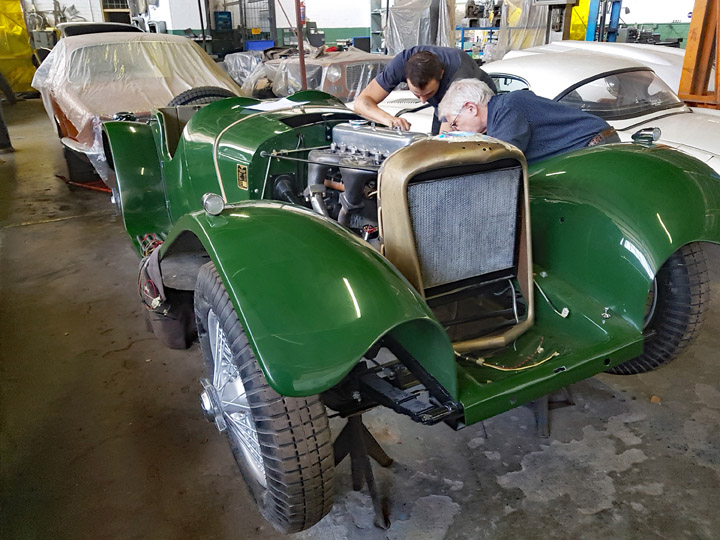
Peter tried to do the conversion himself but limited funds and expertise saw the project stalling so he acknowledged defeat and sought help. Wally Vorlaufer, the Austrian-born guru who’d wrought magic with many old Jaguars, was the man for the job. That gentleman checked it over and proposed: “Better we start again, ja?”
Wally suggested some mechanical modifications, to make it more driveable in modern conditions, without impairing visible authenticity:
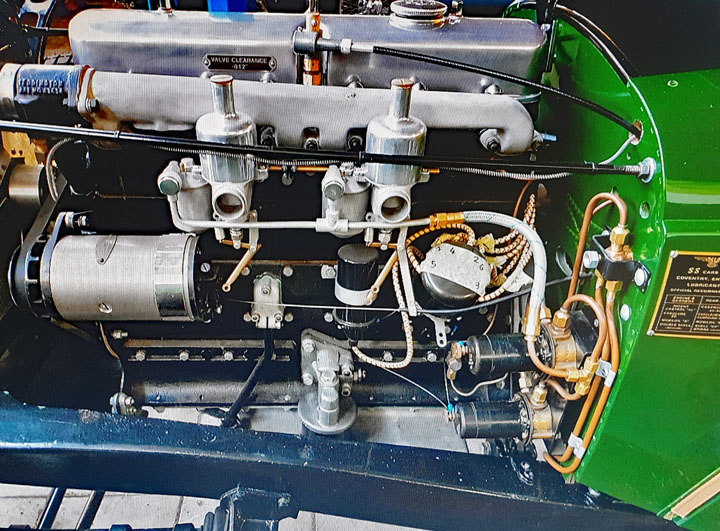
• Engine capacity increase to 2850cc,
• Compression ratio increase to 8.5:1,
• Unleaded fuel-compatible cylinder head components,
• Final drive lengthened from 4.0:1 to 3.8:1 to provide a speed increase of eight-percent in each gear, more relaxed highway cruising, and a theoretical top speed of 170 km/h.
Unfortunately that’s beyond reach because, owing to the body’s flowing front wings, air gets trapped under the car and makes steering uncomfortably light at anything beyond 130 km/h. Its low exhaust note is distinctively SS100, fairly prominent around 4200 rpm, but not unduly intrusive to hot-blooded enthusiasts.
Furthermore the suspension was considered too hard at lower speeds, by modern standards, so each leaf spring had a blade removed to soften the ride. Cruising on the highway, at 120 km/h, Peter’s SS100 rides very smoothly and maintains speed comfortably over long distances.
The body tub is a reproduction, obtained from Ashley in the UK, rebuilt and adjusted for practicality by Vorlaufer’s. Wally manufactured new wings from scratch although the bonnet is original SS100.
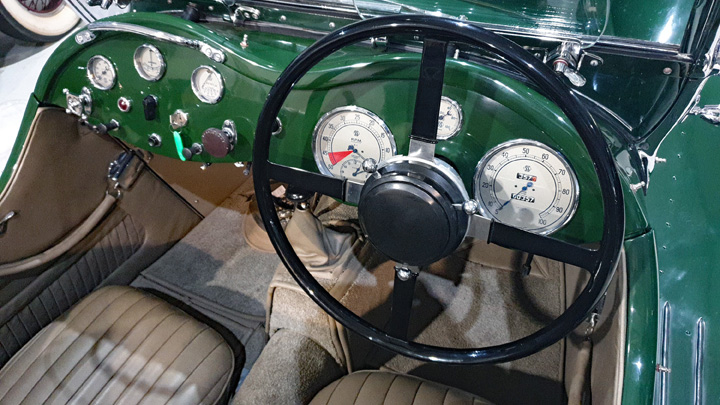
Leg space was a known problem with these cars so the footwell was widened, by 75 mm, although Peter still had difficulty getting his 1.77-metre frame comfortable in the cockpit. Further, substantial, alterations were needed in order to move the seats 200 millimetres rearward.
The cooling system with its original honeycomb radiator isn’t pressurised but, under normal circumstances, engine temperature seldom exceeds 80 degrees Celsius. As a precaution, though, Wally added an accessory electric cooling fan. It was never required on trial runs.
To round it off they fitted high-performance Blockley 5.50 x 18-inch tyres. These feature a period Dunlop Racing tread pattern but modern internal construction, substantially improved traction and better safety characteristics.
The rebuild, spanning four years and some 3500 man-hours, was completed late in 2020. Sadly, however, Vorlaufer Cars went into voluntary liquidation the following year.
Peter’s biggest headache at present lies in persuading South African licensing authorities to accept the car’s bona-fides, so he is coming reluctantly to the conclusion that he might be forced to perform an “original” registration in the UK where it conforms to latest DVLA guidelines.
Some numbers:
Build years: 1936 to 1939
Quantity built: 198 x 2½ litre and 116 x 3½ litre
Engine: 2664 cc, inline six, OHV
Bore x stroke: 73 x 106 mm
CR: 7.6:1
Twin SU carburettors
Power: 102 bhp (76 kW) at 4600 rpm
Torque: n/a
Gearbox: Moss four-speed manual
Final drive: 4.0:1
Wheels: 18″ wire
Tyres: 5.25 x 18
Suspension (Front) Beam axle, semi-elliptical leaf
Suspension (Rear) Live axle, semi-elliptical leaf
Brakes: Girling, rod-operated
Measurements: 153 inches (3886 mm) long, 63 inches (1600 mm) wide, 52.6 inches (1336 mm) high on 104-inch (2642 mm) wheelbase
Weight: 23 cwt (2576 lb/1169 kg)
Body styles in 1936: 4 door saloon, 2 door tourer
Construction: Alloy and steel panels over ash framework (All-steel from 1938)
Price at launch: £395 (+ £10 vs saloon)
0 – 60 mph: Approx. 13.5 sec
Top speed: 94 mph (152 km/h)
Fuel consumption: 20 mpg Imperial (14.12 l/100 km)
Details of Micklewright repro as per text
Note: This model was apparently enlarged in 1937 but accurate information is unavailable because official records were destroyed during WW ll.
Views: 5