A story of one man’s Rover P2
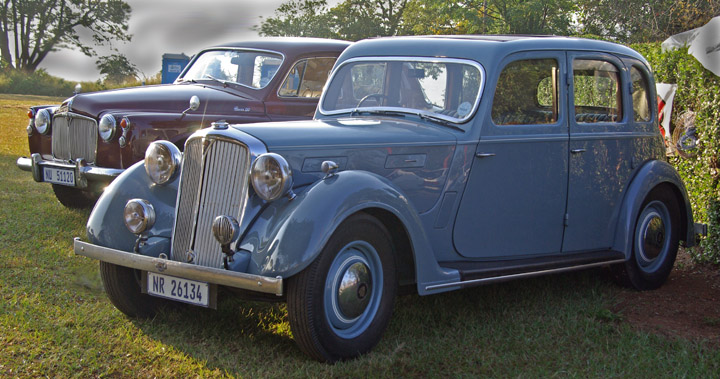
1947 Rover P2 16 HP
Getting by with a little help from one’s friends
Original version published in Weekend Witness Motoring on Saturday April 7, 2012
“Ever seen a P2?” asked the first Rover enthusiast.
“Never,” replied the second, ”I doubt whether there are any in South Africa at all; or even in the whole of Africa.”
“Actually,” offered the third, “I think I might have one in my garage.”
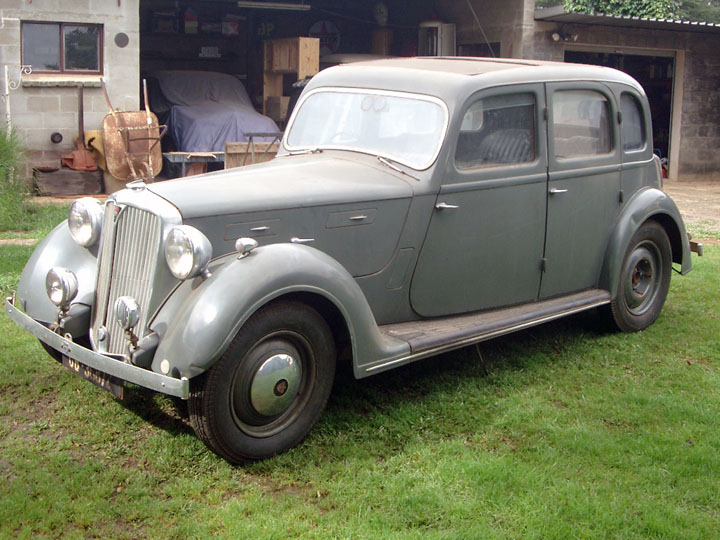
And so he did: Pale greeny-grey it was, with some surface rust spots just appearing and woodwork, carpets and upholstery in need of replacement, but essentially complete. It was a 1947 Rover P2 16 HP, built at Solihull from 1937 to 1940, put on hold for the War years, then continued from 1945 to 1948, when it made way for the P 3.
The enthusiasts in question were Clyde Wyatt, referred to affectionately as “the foreman,” Rob North, provider of workspace and an encyclopaedic knowledge of all things Rover, and Cedric Macdonald, owner of the almost-forgotten P2. They got together most Mondays to chat, have tea and work on the car.
In the glove box was an ancient Shell logbook detailing fuel and oil top-ups and consumption calculations. The final entry was on February 13, 1963, when its owner purchased 9 gallons and four pints of petrol at 87330 miles. The odometer now read 87331, so we can be pretty sure of the date on which the then-sixteen year old Rover breathed its last. It was left with a Grahamstown-area farmer but never reclaimed.
The agriculturalist in question passed away some years later with the undertaker, Odi Inggs, taking the Rover in part payment for his services. Inggs in turn parted with it to his old mate Macdonald, who trailered it home and forgot about it for 30-odd years. That is until the conversation outlined above, because other projects had demanded his attention in the meantime.
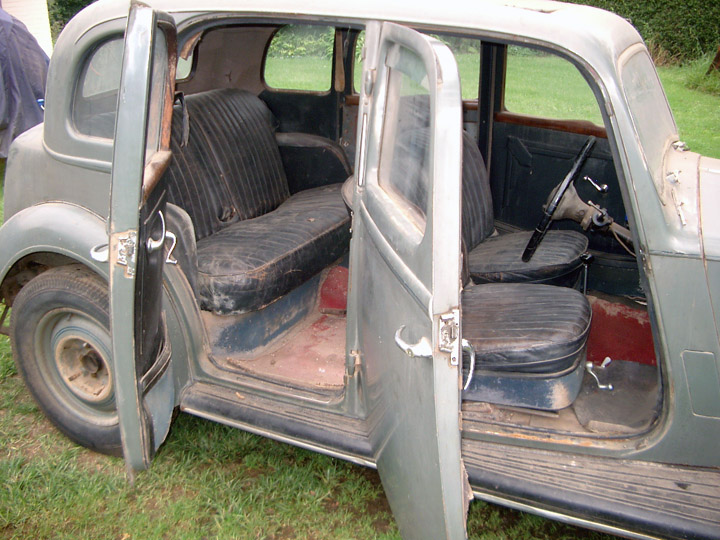
Not much is known about the original owner apart from the fact that he farmed near Port Elizabeth, was ex-military and loved fishing. A rubber stamp on a document confirmed the first two, while bulging door pockets filled with fishing line, hooks and other paraphernalia confirmed the rest. Sea sand in body crevices and in chassis cross members indicated that his preferred fishing spots were at local beaches. The chassis, once the body had been separated from it, was found to be buckled, indicating either extremely rough farm tracks or some off-road adventuring.
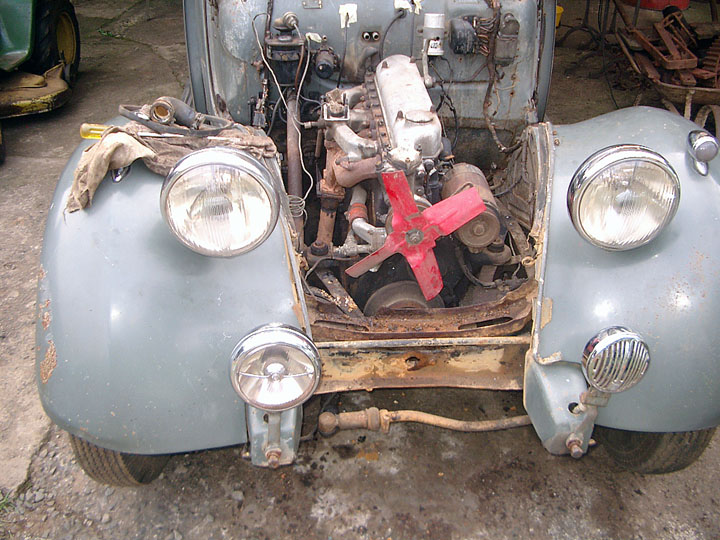
It turned out that, although he had kept strict records of fuel and oil purchases, routine servicing had not been a priority. The engine was seized solid and, instead of finding ancient oil in the sump, Macdonald and his helpers found jelly-like sludge. It was so bad that the camshaft had to persuaded from its nest with a hammer, while the main bearings were worn away to nothing and wear on other mechanical parts was severe.
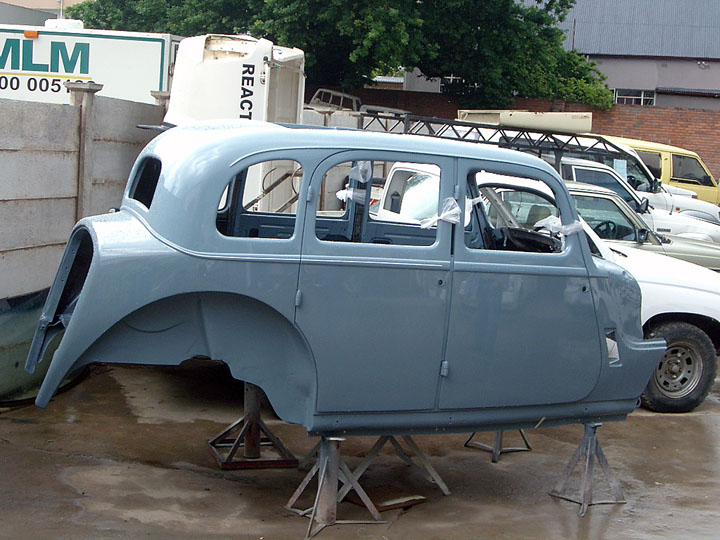
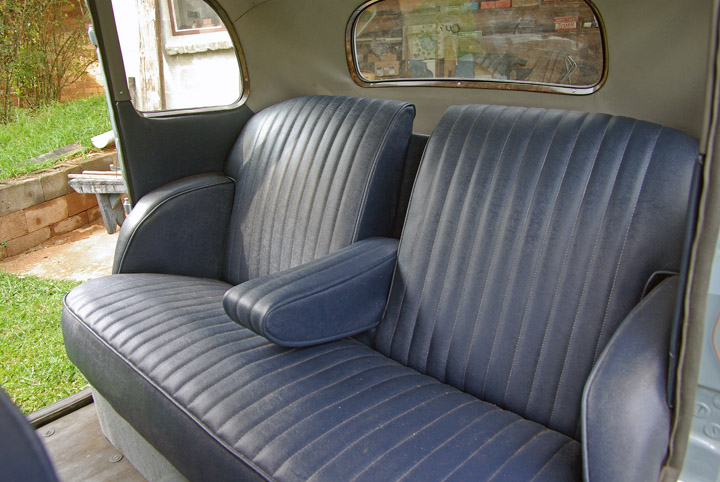
While the team set about stripping, straightening and repainting the riveted ladder frame chassis, the body and seats were sent out to specialists for refurbishment in its new colour scheme of two-tone blue-grey with blue upholstery. Then followed cutting and remaking of rotted wooden floor panels and sunroof framework. They refurbished door panels, carpeting and headlining, and stripped and revarnished the decorative wooden trim on doors and dash. Sun visors, windscreen hardware and dozens of other items needed attention, so the team cleaned, resurfaced and repaired those as well.
The engine parts were then sent to McKenzie Auto Engineers in Pinetown for machining and repair. This part of the project was delayed for some time owing to non-availability of crankshaft main bearings, a problem eventually overcome with assistance from Bob McCosh of Federal Mogul. He helped source the needed materials and to build up a one-off set. Once everything was ready, North, the most mechanically knowledgeable member of the team, tackled assembly of the engine.
Despite best intentions, the car wasn’t complete in time for Weekend Witness/VSCC Cars in the Park 2012, so it was reassembled as a rolling dummy for display as a work-in-progress.
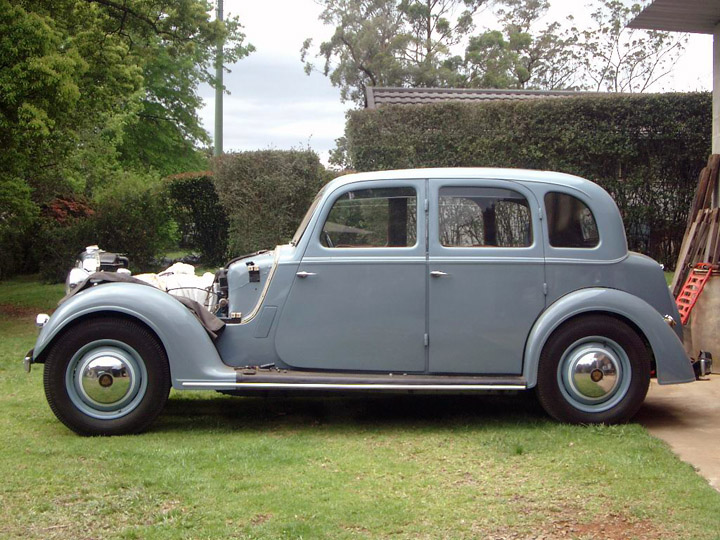
But the best things take time; skip forward two-and-a-half years to October 2014 when Rob North reported via email:
“We have achieved a significant milestone – The engine runs – beautifully.
“Yes, after the long-winded overhaul, for some reason the engine was very tight and the starter was unable to turn it over. Some freeing-off was necessary so we towed it round the garden in gear with the spark plugs out. After many laps, it freed off sufficiently for the starter to work and, once the timing was correctly set, she started up easily and runs beautifully. From our calculations, it has been 51 years since the vehicle last ran!
“The next step is to sort out an “S” licence so we can use it on the road and try out the mechanical brakes – adjustment of all those rods is new to me! The main work still to be done is the cover of the gearbox. The original was a rubber tunnel and completely perished. I have made up a metal copy which has to be more exact in dimensions than the rubber one.
“We have had a lot of hassle with the rear springs. Being an underslung chassis at this point, makes setting requirements more exacting. We have had them reset three times and still the rear end appears low without any passenger load.. We also need to drive it a bit to get them to possibly settle. We have no reference to ride height dimensions.”
At this point in his email, Rob asked John (a reader from Melbourne, Australia and owner of a 1946 P2 12HP Sports Saloon), if he could please measure the clearance heights under the mudguard lips to the ground on his car, unladen, front and rear as this would be a big help.
John indicated his willingness to assist but pointed out that his car, now also elderly, appeared to be suffering from spring sag as well. (Sigh: Don’t we all, eventually?)
Foot note: According to a Wikipedia entry found at the time the original article was written, there were 25 surviving Rover P2s in the world, with 10 of them running. We have since been informed that the number of survivors is actually higher.
While on the subject of the free online encyclopaedia, we thought you might enjoy this extract from an entry we found in October 2016:
Rover 16 (P2)
Manufacturer: Rover
Production: 1937–1940, 1945–1948
Body and chassis
Body styles: four-door “six-light” saloon, four-door “four-light” sports saloon, two-door drophead coupe.
Powertrain
Engine: 2147 cc straight 6
Dimensions
Wheelbase: 113 in (2,870 mm)[1]
Length: 175 in (4,445 mm)
Width: 62.5 in (1,588 mm)
Chronology
Predecessor: Rover Meteor 16
Successor: Rover 75
“The Rover 16 was a medium-sized family car announced in mid-August 1936 and produced by the British Rover car company between 1936 and 1940 as a successor to the Rover Meteor 16. It was put back into production in 1945 following the Second World War and remained on sale until replaced by the Rover P3 in 1948. The 16 was part of the Rover P2 range, along with Rover 10, Rover 12, Rover 14 and Rover 20 models.
“The car, with its mildly streamlined form, resembled the existing Rover 10 and the Rover 12 but was slightly longer and featured a more rounded back end. The six-cylinder ohv engine had a capacity of 2,147 cc. A top speed of 124 km/h (77 mph) was claimed. In addition to a “six-light” saloon and a “four-light” “sports saloon, a two-door cabriolet was available, usually referred to as a drophead coupé, with bodywork by Tickfords.
“The sports saloon and the drophead coupé had slightly less length between the front and rear seats, but a longer bonnet, with the front footwell extending further beneath the bonnet.
“A version called the Rover 14 saloon combined the same body with (from 1938) a 1,901 cc six-cylinder engine. There was also a version called the Rover 20 with a 2512 cc. engine.
“Notable features included a “freewheel” system, Bijur-Luvax automatic lubrication of the chassis, and Girling rod actuated fully compensated mechanical brakes of exceptionally high efficiency.Road test
“Said the correspondent of The Times, ‘The Rover Sixteen is exceptionally attractive by reason of its quiet gentle manner, sweet running, comfort and spruceness in and out.’ Further lengthy comment was lyrical. The sole concern was that the engine could, with advantage, be rather more powerful. Comfortable maximum speed was 75 mph.
“The Rover 16 saloon returned to production almost unchanged after the war, although the drop head coupe version was no longer listed.”
END
Views: 4