Original story by: Lennie Gouws on the Heritage Portal
Pics supplied
Going the hard way
Others tried, and failed, to be first to travel by motor vehicle from Cape Town to Cairo.
Major Chaplin Court-Treatt, his South African-born wife Stella, her younger brother Colin as assistant mechanic and CT’s former employee Julius Mapata, succeeded in doing so for the first time, in 1926, taking 16 months to do so.
Son of a Malawian chieftain, Mapata could, apart from English, speak 32 local dialects. In Sudan, a man named Musa was employed to translate further. He remained with the expedition to its end.
Imagine the blood, sweat, tears and the mosquitos that cover every exposed area on your body like a grey crust. There were mud swamps, up to 20km wide, to be crossed and they got lost in the desert. The first Christmas was spent in pouring rain under a leaking tent; one member had a broken arm and another an almost deadly insect bite. Sometimes they were only able to cross rivers by dragging the vehicles, under water, along the bottom.
They might have thought twice had they known all this beforehand.
The route the Court-Treatts chose was purely over colonial territory. Stella Court-Treatt wrote in her book, Cape to Cairo, published in 1927: “The desirability of blazing a trail through British Africa was superior to every other consideration.” They later acknowledged that another route would have been shorter and easier.
Cape Town is 7 241 km from Cairo as the crow flies but modern electronic route planners indicate that the road is 9 654 km long.
The Court-Treatts departed Cape Town on 23 September 1924 and after 16 months reached Cairo on 24 January 1926. They had travelled 12 732 miles (20 490 km); the same distance as London is from New Zealand. Two French expeditions, travelling from north to south at the same time, completed the journey in eight months.
Court-Treatt – generally known as “CT” – personified Rider-Haggard novel heroes with his double-barrelled surname, lean stature, resolute jawbone and ever-present pipe in mouth. Stella wrote that he was taller than the proverbial 6 feet (1,82 m) and that his character was as strong as he physically was in size. In spite of this he was sweet-natured and friendly, never lost his head and always remained calm and composed in difficult situations.
CT knew Africa. By the end of WW1 he was a member of the Royal Flying Corps (RFC) and was stationed in Egypt when the armistice was announced. After the war he stayed on as an officer in the Royal Air Force (RAF) and was a member of the team tasked to plot an air route from Cairo to Cape Town. He commanded the group responsible for the section between Abercorn (now Mbala in Zambia) and Cape Town, a distance of about 2000 miles (3200 km). This was completed in 1922. He remained in South Africa where he met his future wife, Stella. They married in 1923.
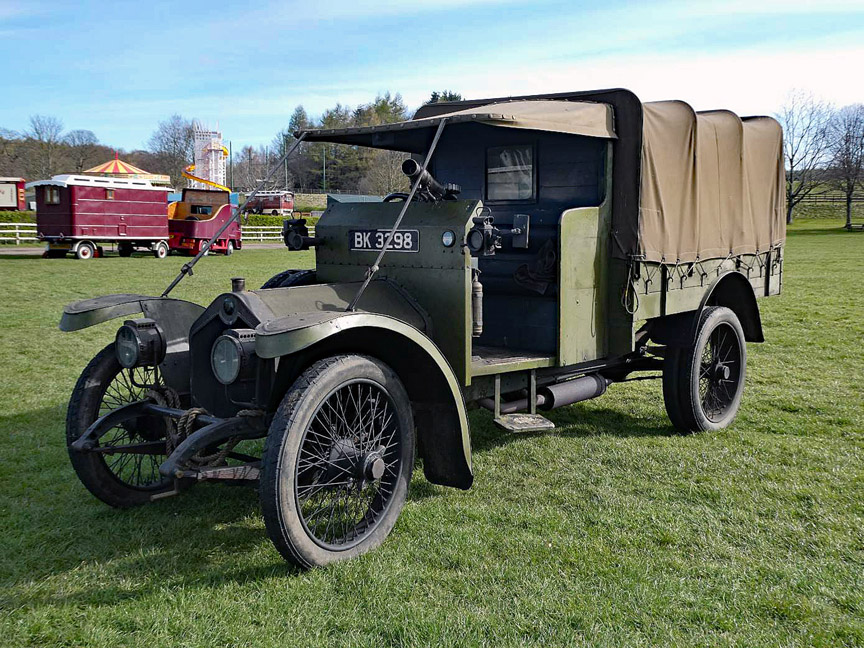
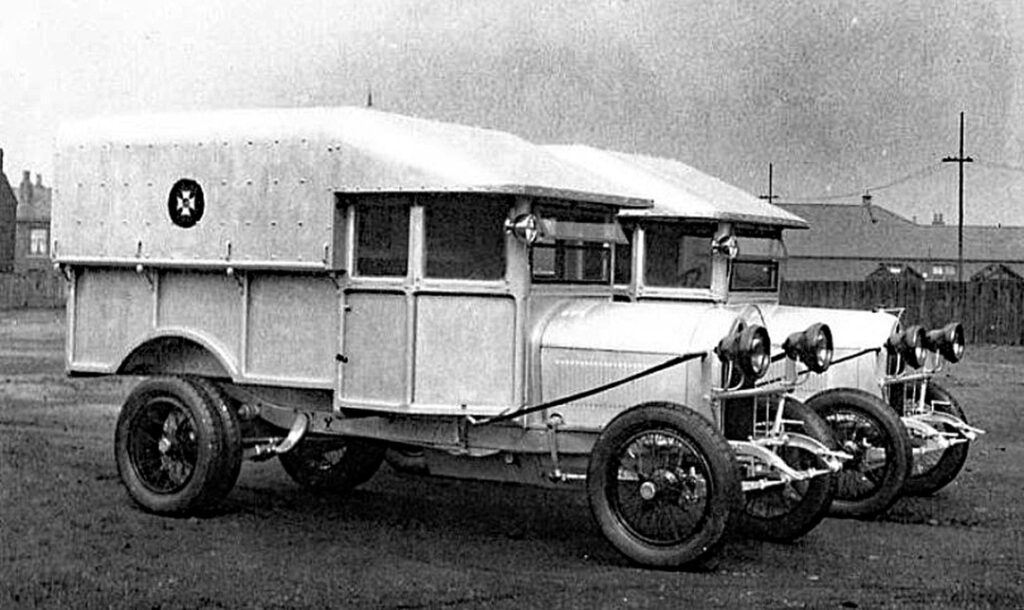
CT used Crossley vehicles during the War when they served the RFC as light trucks (tenders) and staff cars. Impressed with their ability to traverse rough terrain, he bought two updated, post-war, models; choosing the adapted 25/30 chassis specifically developed for the RFC and offered with various bodies. His expedition vehicles were modified by raising the suspension. Each could carry just over a ton in payload. The bodies were painted silver-grey and the aluminium roofs could theoretically be removed, bolted together and serve as pontoons to carry the vehicles across rivers. Mosquito netting over windows, and extra water tanks, were installed.
Provisions, food and spare parts were sent ahead to 27 places along the route. To get these to their destinations was in itself an expedition. Some could be sent by rail. In the Sudan, they used camels, but in some distantly situated areas, human carriers manhandled loads over hundreds of kilometres. Waypoints included Johannesburg, Nyamandhlovu (about 40km northwest of Bulawayo in Rhodesia, now Zimbabwe), Mwaya Beach (Malawi), Nairobi and Khartoum.
Baggage was limited to the absolute minimum. One luxury was a gramophone. A sizeable stash of weapons and ammunition was included; not to defend the expedition, but to shoot meat for the pot. Breakable items such as cameras had to be specially packed to survive the treacherous terrain. Canadian photographer and cinematographer, Thomas Glover, joined the expedition to record it.
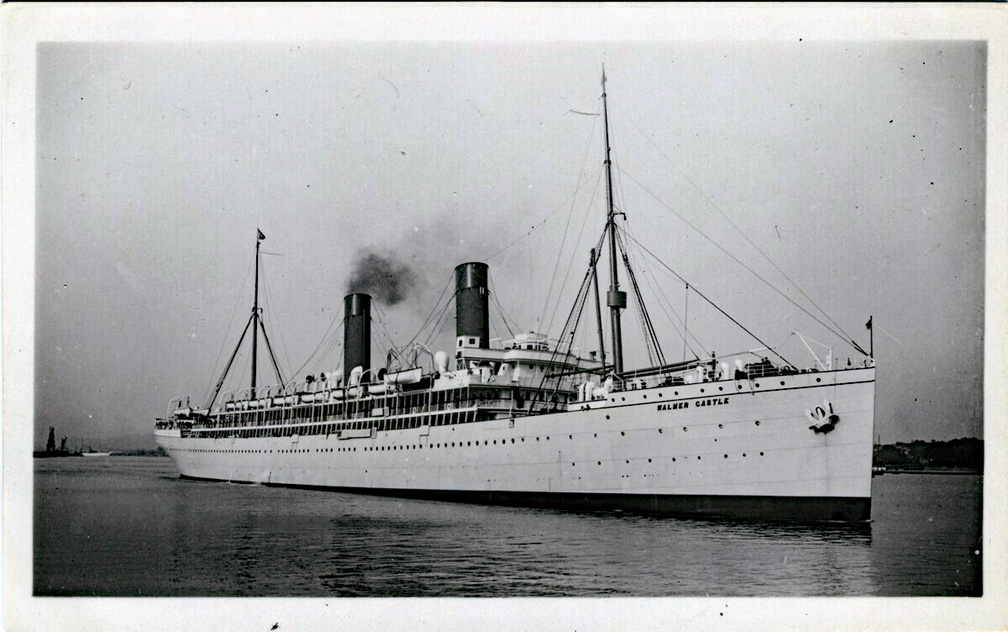
Each member of the expedition had his or her designated tasks. Stella did a course in elementary medical care. She also had to mend all clothes and later said: “I hope never to darn another stocking in my life.” After eight months of preparations, the Crossleys were loaded onto the RMS Walmer Castle, accompanied by the Court-Treatts and the rest of the company. The group arrived in a rainy Cape Town on 15 September 1924.
Views: 31
Leave a Reply