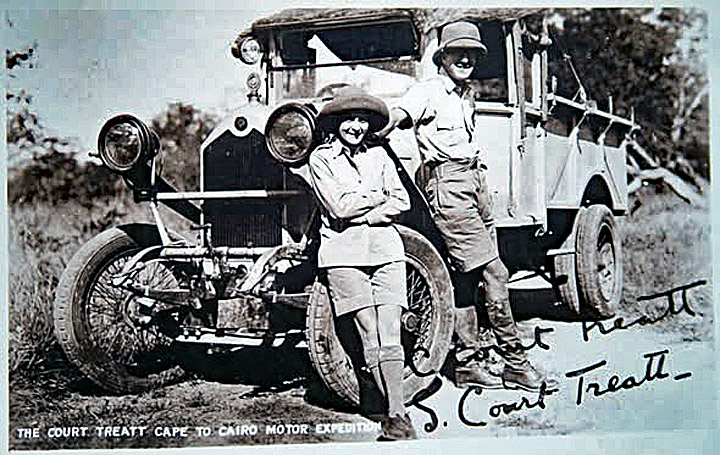
The end in sight
Original story by: Lennie Gouws on the Heritage portal
Postcard pics from South African Nostalgia on Facebook
The company camped out for a few months, in southern Tanzania, to give Thomas Glover opportunities to film wildlife. They departed in mid-October. After meeting the Governor-General and his wife in Nairobi, the journey to the Sudanese border proceeded rapidly; reaching Mongala, 1280 km away, in eight days.
Ahead of them lay the infamous Sudd swamp. The name means “blockage” or “obstacle”. It’s one of the largest wetlands in the world but the expedition declined advice to circumvent it by steamboat. They did, however, use one to cross the upper Nile.
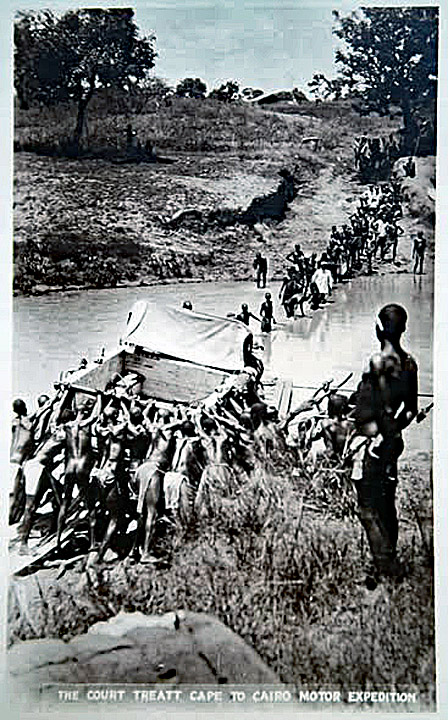
Those 1700 kms of oppressively hot, malodourous, mosquito-ridden, swamp taxed the team severely. Dinka tribespeople assisted by dragging the Crossleys through. The team all fell ill, but soldiered on.
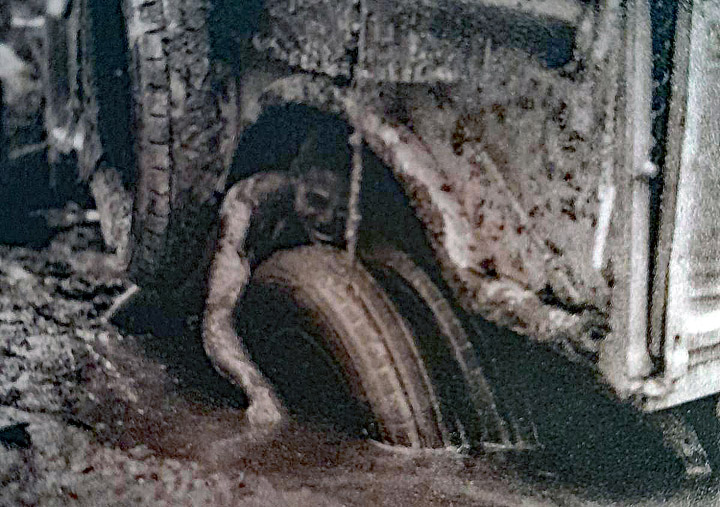
The vehicles were repeatedly hauled, underwater, through rivers after draining fluids, plugging openings with wooden blocks and wax and lashing steering wheels with minimal give. The first time was at the Bahr-el-Gell River. Two ropes were tied to the front and fifty people heaved. A float was tied to the ropes in case they broke. They did.
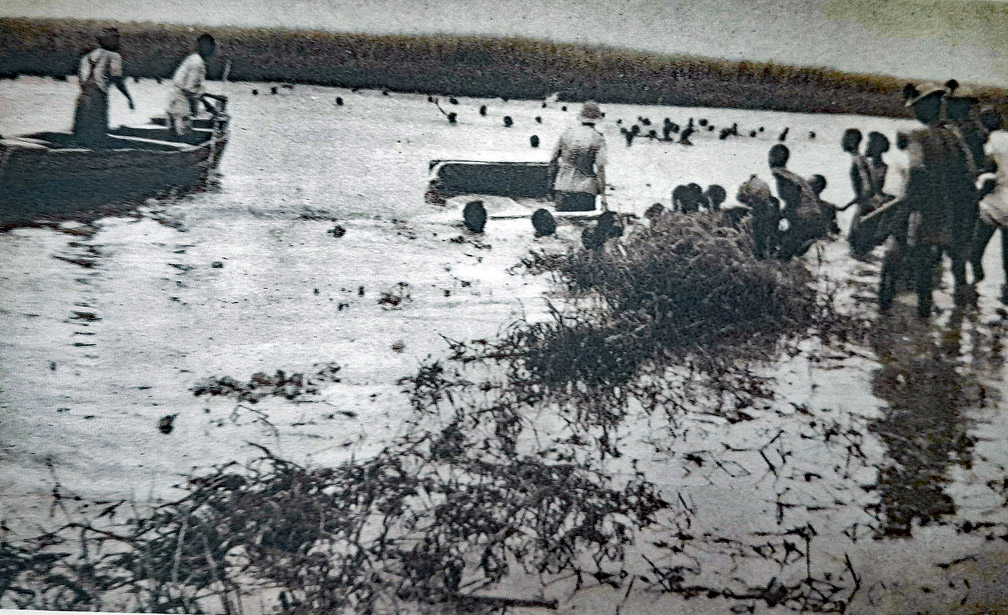
C-T remained on each Crossley while it was dragged. Once, he and vehicle disappeared underwater completely while he clung to the steering wheel with hands and feet. The onlookers eventually saw bubbles and the vehicle emerged slowly from the water. But, just as they thought the Crossley was through, it dropped into a trough. The only remedy was to dive in, scoop out mud and build an incline against which the vehicle could be dragged free.
They reached Wau, where Musa joined them, on 14 November. He spoke Arabic, Swahili and a smattering of English. To communicate, CT routed messages via Julius who translated into Swahili for Musa, who sometimes had to find an Arabic-speaking Dinka for further translation.
The next big river was the Bahr-el-Arab, a tributary of the Nile. Adjacent swamps were, in places, up to 13 km wide. There were no maps but a crossing had to be found. En-route to one possibility, some youngsters burned grass to make a road. This got out of hand and the vehicles were almost destroyed.
Arabs, not well-disposed towards the Dinka, lived across the river. There is, to this day, still ethnic conflict in the area. Four Arabs, caught on the Dinka side of the river, were unwilling to indicate where they had crossed but were eventually persuaded to show where the crossing was.
The river was about eight metres deep at this point but C-T believed that a bridge could be built. There were no trees nearby so logs had to be carried a long way. The bridge was ready on 5 December. They reached the opposite bank but still had to cross the swamp.
Being Arab territory, the Dinkas were unwilling to help but were eventually persuaded, with two antelope carcasses, to drag the cars through the swamp on the Arab side.
This was not the only river to cross and, in places, branches and leaves had to be packed over sodden ground so the vehicles could proceed. In other places elephants created immense potholes in roadways. Each car suffered a broken wheel as a result. They repaired one and departed in it to their next destination, El-Obeid, about 64 km away. Spare parts were brought in from Khartoum for the second vehicle to be repaired and collected.
Their second Christmas on the expedition saw them camping in the desert. Memories of the previous, soggy, Yuletide occupied everyone’s thoughts. Julius acquired a festive turkey in El-Obeid and had it cooked.
The next destination was Khartoum and the expedition progressed swiftly. They covered about 180 km per day, sometimes reaching speeds up to 65 km/h. Although forewarned that travel from Haifa in the Sudan, to Shella in Egypt, was impossible, they tried anyway. Rough terrain caused many flat wheels and breakages and they became completely lost. Food and water stores became dangerously low, but a search-party from Aswan luckily found them.
A Felucca, a traditional Egyptian sailboat, transported the Crossleys over the Nile on a platform specifically installed to carry vehicles.
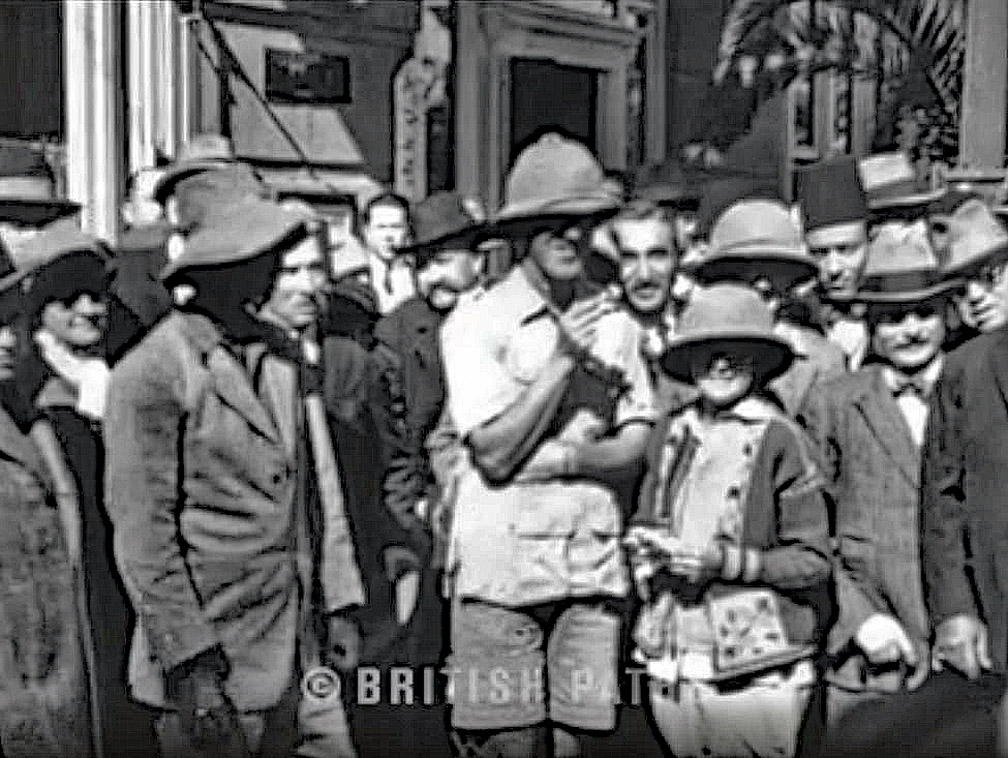
They were welcomed at Giza with flowers, reporters and cameramen. The road from there to Cairo was closed so they could travel on it. Crowds of onlookers greeted them enthusiastically. This was 24 January 1926, the final day of the expedition.
The Crossleys were then loaded onto a ship in Alexandria for transportation to Marseilles, before travelling under own steam to Calais where a ferry took them to England. Radio broadcasts, newspaper reports and parties followed.
The Crossleys were taken on a publicity roadshow that crossed all of Britain. At the same time Glover’s film about the expedition was shown. What subsequently happened to the vehicles remains unknown.
END
Views: 8
Leave a Reply