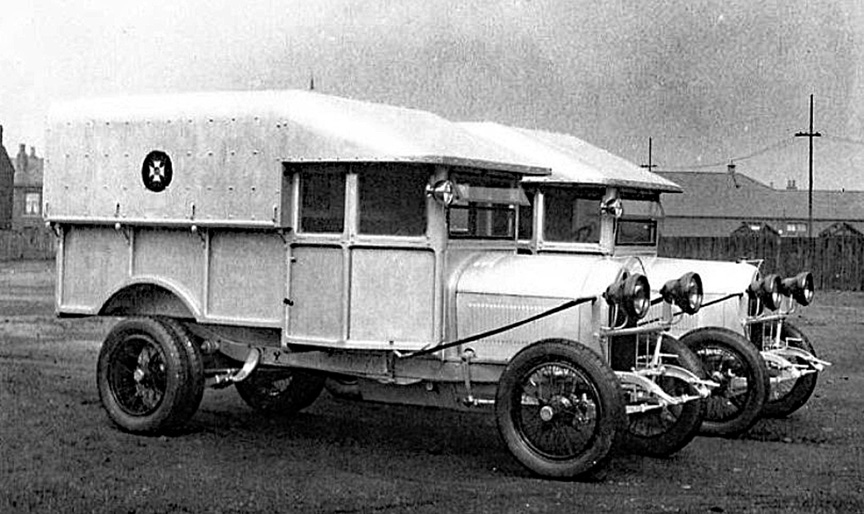
Crossley 25/30 expedition cars
Early innovation
Crossley Motors was an interesting company. It boasted a number of “firsts” – some of which might tip a few “sacred cows” tail-over-horns – but let’s begin at the beginning:
The company was founded in 1867 when Francis Crossley bought an engineering business that made pumps, small steam engines and other mechanical devices. They took designs and developed them further with improved valves, more efficient ignition systems and a new device; the carburettor. This had been designed variously by Karl Benz and other contemporaries although the modern, spray version, was perfected by Wilhelm Maybach.
Among other “firsts”:
• Obtaining British and World (outside Germany) rights to the Otto Cycle four-stroke engine in 1875,
• Acquiring rights to an early diesel-style engine and building its own version, in 1896, about a year before Rudolph Diesel filed his patent.
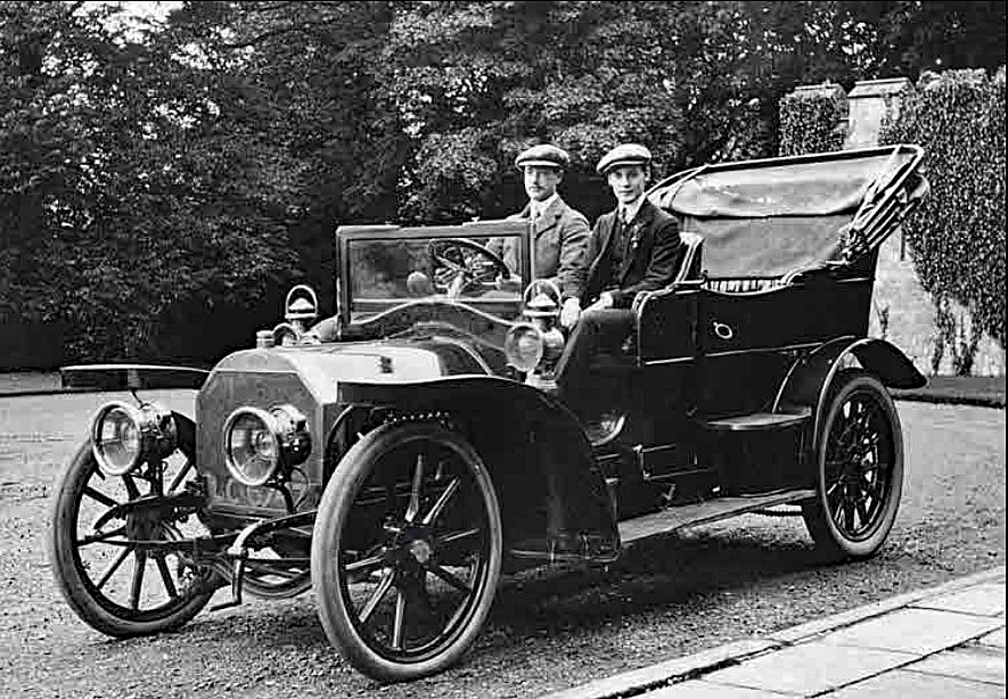
By the turn of the century Crossley’s petrol engines were finding their ways into road vehicles and, encouraged by car dealer Charles Jarrott and Letts of London, Crossley developed a 22-hp open tourer in 1904. It thereafter bought the dealership, formed Crossley Motors in 1906 and started building its own “English Mercedes.” Car production was spun off, in 1910, leaving the founding firm to continue its original activities.
The open tourer was followed by a seven-litre, 40 hp, model with chain drive and a pump that circulated water through the engine for cooling. Both models were fitted with four-cylinder motors and delivered complete or as powered chassis’. This allowed customers the option of choosing their own coachbuilders. An early design change saw chain-drive replaced by a shaft.
Next, in 1909, came the 12/14; one of the first cars to have engine and gearbox fitted in-line down the chassis. It was powered by a 2.3-litre four-cylinder producing 15 hp. The following year, Crossley continued the “15 hp” name but increased capacity to 2.6 litres.
Then came the 20/25; bought in volume by the British Army and its newly-formed Royal Flying Corps, as staff cars and light trucks. Manufactured for about ten years, production exceeded 10,000 thanks to military sales that included some ambulances and equipment carriers.
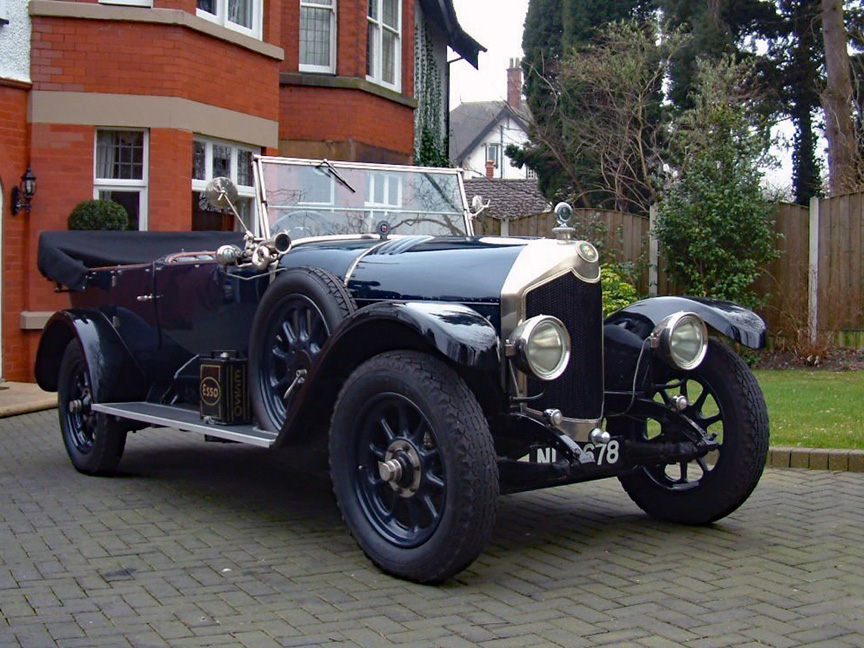
After the war Crossley resumed civilian vehicle fabrication with a new model, the 19.6, fitted with a 3.8-litre four with detachable head. Like most engines of its time it utilised side-valves. This model spawned the 75-bhp, 20/70 sports version with performance-boosting features in use today; high-lift camshafts, higher compression, improved fuel delivery and lightweight wheels. It was joined in the early 1920s by a 2.4-litre, 14 hp, version.
When the army began selling off surplus staff cars, Crossley introduced a slightly redesigned model called the 25/30 or “RFC” (listed as Type J by Quartermasters). Versions included a 19.6-based six-wheeler.
Crossley built its first six-cylinder engine in 1925 and fitted it to a new model, the 18/50 or 20.9. This started as a three-litre but, because of excess weight, it was soon increased to 3.2 litres for more power. Then, to bolster business, Crossley launched a range of trucks and busses that would be its eventual salvation.
Because its car sales had been slowing (too luxurious and too expensive) during the 1930s’ Great Depression, Crossley developed its final model, the 26/90, in 1937. It’s believed that only one example, fitted with a 3.5-litre Studebaker motor, was built before production was stopped in favour of busses, commercials and military vehicles.
Fittingly two updated, modified and more powerful, post-war 25/30s served the Court-Treatt expedition on its pioneering, South-to-North, crossing of Africa between 23 September 1924 and 24 January 1926.
Some 25/30 numbers
Engine/gearbox/transmission
Capacity: 4531cc
Cylinders: Four, cast in pairs
Bore: 4 inches (102mm)
Stroke: 5 1/2 inches (140mm)
Compression ratio: 4.29:1 (fixed head – early), 4.64:1 (detachable head – late)
RAC Horse Power: 25.6
Carburettor: Smiths 5 jet
Valves: Side
Lubrication: Full pressure fed
Ignition: Magneto (Lucas EB4)
Max power: 45 bhp (33 kw) @ 1750rpm (fixed head)
62 bhp (46 kw) @ 2300 rpm (detachable head)
Fuel consumption (typical): 13-15 miles per gallon (20 litres/100 km)
Max speed (approx): 60 mph (95 km/h)
Acceleration: n/s
Gears: Four forward and one reverse gears. Right hand change.
Clutch: Cone type See: https://www.youtube.com/watch?v=3ORIWwh8NdI
Drive: RWD, shaft:
Rear axle: Spiral bevel 4:1 ratio, straight cut (WD spec) 4.07:1
Electrical system: 12 Volt.
Body/chassis
Wheelbase: 11 feet 3 inches (3429 mm)
Length: 15 feet 5 inches (4572 mm)
Track: 4 feet 6 inches (1372 mm)
Width overall: 6 feet (1829 mm)
Weight: Tourer approx. 38 cwt (1930 kg), saloon 40 cwt (2032 kg)
Steering: Worm and roller
Suspension – front: Semi-elliptic springs
Suspension – rear: Three quarter-elliptic springs
Brakes: Handbrake operating on rear wheels, foot operated transmission brake.
Wheels/tyres: 30-inch rims, doubled at rear, with 920 x 120 beaded edge (tourer), 895 x 135 beaded edge (saloon, landaulette and coupé)
END
Views: 18
Leave a Reply