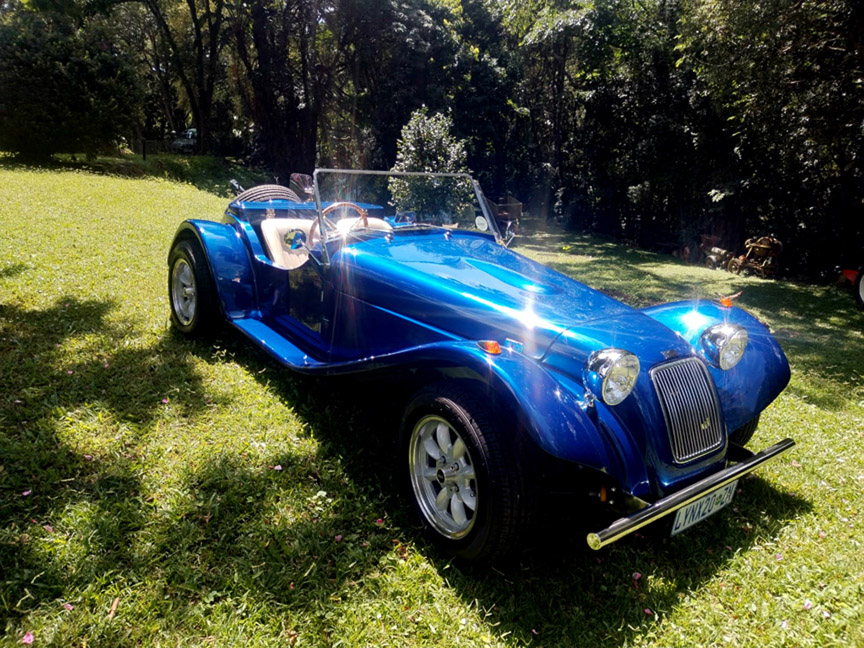
Son of Merlin
Pics by owner
Kit Car Centre (Pty) Ltd – under the watchful eye of founder-owner Rudi Malan – was based in Kempton Park and, from information available, was in business for about 23 years before closing in 2003.
The following description appeared in its sales brochure:
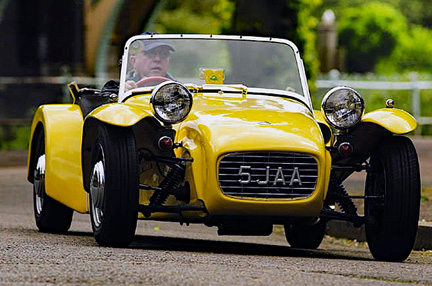
“The Lynx Roadster is a South African reproduction of the Merlin kit car from Britain.
“It affords individuality in today’s motoring world where mass produced cars seem all too similar. Enthusiasts, seeking performance and handling, will be rewarded beyond expectations.
“Building a Lynx Roadster is where the enjoyment begins. Being custom-built, it allows one to tailor it to exact taste and performance requirements; economical Sunday cruiser with 1,6- or 2,0-litre engine, or fierce road-burner with a 3-litre V6.
“Designed so that a novice can build it, in a home workshop, no special skills are needed. Each kit comes with a detailed manual for guidance, and expert advice is only a phone call away.
“A specially fabricated chassis accepts the front and rear suspension of Ford Cortina Mk 3, 4 or 5. It is fully bracketed and drilled to bolt suspension, steering and brake components on to it. Engine and gearbox mountings are built-in to accept Ford four-cylinder (1,6- and 2,0-litre) and three-litre V6 engines. It can accept almost any other make of four-cylinder engine but suitable mountings would need to be specially fabricated.
“The glass-fibre body is a high-quality, hand-laminated, moulding that’s colour-impregnated to the buyer’s choice of colour (two-tones also available) – no painting needed, no rust problems. Based on the popular Ford Cortina’s mechanical components, it is both easy and cheap to maintain, making it all the more pleasurable to own.”
Come 2022: Pietermaritzburger Dave Tanner, a retired engineering Diplomate, managed to locate and purchase an unused, complete, Lynx Roadster body shell with a few accompanying bits and pieces. He already had a retired, Pinto-engined, Ford Cortina 2.0-litre as donor for mechanical parts.
Then the fun started; stripping, cleaning and reassembling various components before painting. During this process things like seals, bearings, etc. were replaced with new parts. All wearing components in the front and rear suspensions were replaced as well.
The 2.0 litre engine was fully overhauled with new pistons, rings, bearings, valves, oil- and water pumps, electronic distributor and cambelt with tensioner. The Ford type-9, five-speed, transmission was also overhauled. Parts for this had to be shipped in from the UK. Motor engineering, propshaft shortening and balancing, radiator recoring, and upholstery were all outsourced, but Tanner did the rest himself.
An interesting part of the build was to not use the donor car’s live back axle but to substitute a complete, independent rear suspension, unit from a Ford Sapphire 2.0 GL. This ensured having the correct differential ratio. It took some thinking and engineering to successfully do so but the result, and time taken, was worth the effort.
Once the chassis was sorted the various rebuilt, and freshly painted, components were fitted. Then, after removing it from the assembly trolley to stand on its own wheels, the body was trial-fitted to ensure that doors, boot lid and bonnet lined up as they should. Once done, it was returned to the assembly trolley to prepare for painting.
Then came sanding. and filling of tiny pin holes. Tanner estimated that he spent over 200 man-hours on body- and paintwork alone. The body was fitted back onto the chassis once all the brake- and fuel piping had been fitted.
Much time was spent making various components to complete the car. For example a pedal box had to be fabricated to fit into the confined space and function correctly; the vacuum-assisted brake booster needed fitting into the drivers footwell, linked to the dual-circuit brake master cylinder in the engine bay, and then coupled together to hold the vacuum. The rear brake line was fitted with an adjustable bias controller to enable correct braking balance.
When KCC closed in 2003, that source of special kit components also came to an end. Things like badges, grille and windscreen frame, to name a few, were no longer available. Tanner fortunately managed to source a second-hand grille from a member of the Lynx Car Owners’ Club in Gauteng. With the aid of a photograph of the badge he was able to find a company in Pinetown to laser-etch one for him. He crafted the windscreen frame, using homemade dies and rollers, from aluminium section.
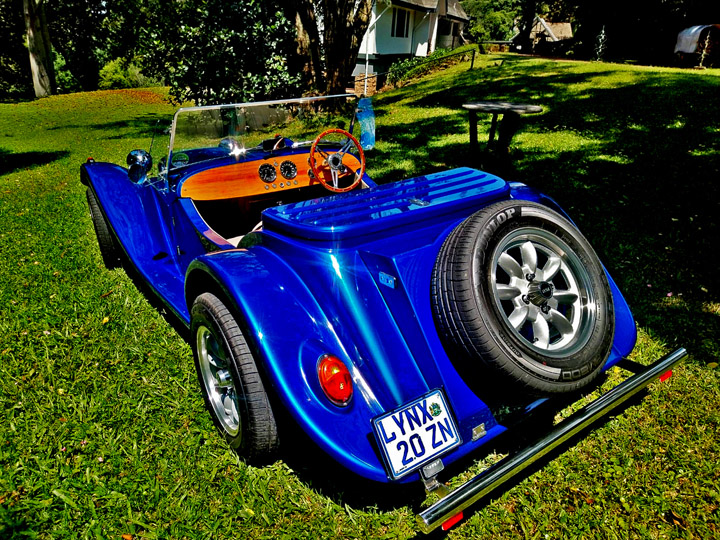
Later, with chassis and body rejoined, came fitting of exterior components – windscreen, lights, mirrors and bumpers – followed by electrical wiring and testing to ensure that everything functioned as it should. The dashboard, made from a sheet of Blackwood that had been in storage for over 50 years, houses the Smith’s gauges. The interior was then carpeted and seats fitted.
The car was finally started, after making sure that all fluids had been put in, followed by a test run around the block. A few minor adjustments later, the car was ready for its mandatory Roadworthy test and issue of licencing documents, in February 2025.
The numbers
Engine: Ford “Pinto” 1993 cc, SOHC four-cylinder naturally aspirated
Bore x stroke: 90.8 mm x 77 mm
Head and block: Cast iron
Carburettor: Weber DGAV 32/36
Power: 81 kW at 5500 rpm
Torque: 163 Nm at 4000 rpm
Dimensions: 3290 mm long x 1680 mm wide x 1200 mm high
Ground clearance: 135 mm
Tare mass of Cortina: 1090 kg
Tare mass of Lynx: 900 kg
Zero to 100 km/h: Cortina, 11.2 seconds. Lynx, not measured but pdq
Maximum speed: Cortina, 167 km/h. Lynx, not measured but sufficiently rapid
RPM at 120 km/h in fifth gear: 3200
Views: 32
Leave a Reply