Words by Axel von Tramp
Pics by owner
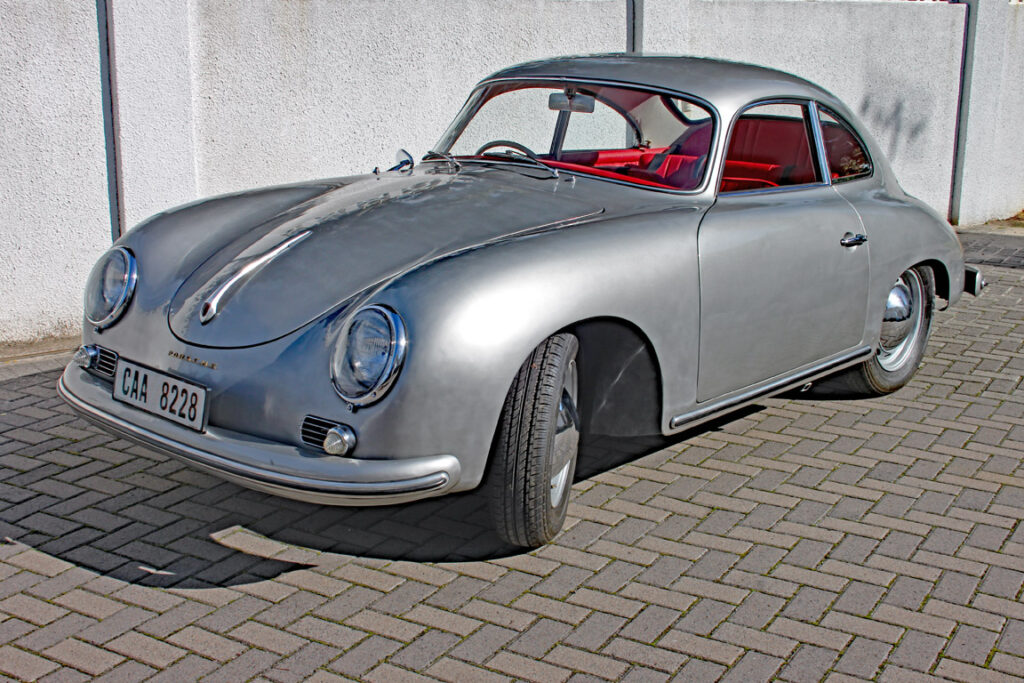
One man’s project: 1958 Porsche 356A 1600 S Coupé, Type 2
Born to be Silver
Introduction:
The 356 was created by Ferdinand “Ferry” Porsche, son of Ferdinand Porsche, founder of the German company. Ferry, in his turn, founded the Austrian company with his sister, Louise Piëch. Like its cousin, the Volkswagen Beetle (that Ferdinand Porsche Sr. had designed), the 356 is a four-cylinder, air-cooled, rear-engined, rear-wheel-drive car with seamless pressed and welded steel box frame and one piece with body construction.
The chassis was a completely new design, as was the 356’s body, penned by Porsche employee Erwin Komenda. Certain mechanical components, including the engine case and some suspension parts, were based on and initially sourced from Volkswagen.
The first 356 was road-certified in Austria on June 8, 1948 and was entered into a race in Innsbruck, where it won its class. Porsche then re-engineered and refined the car with a focus on performance. Volkswagen and Porsche shared fewer parts as the 1950s progressed.
Porsche handcrafted the early 356 automobile bodies, at Gmünd, in aluminium but when production moved to Zuffenhausen, Germany, in 1950, models produced there were steel-bodied. The early aluminium-bodied cars are now referred to as prototypes. Porsche contracted Reutter Carosserie-Werke to build the steel bodies and eventually bought that company in 1963. Reutter retained the seat manufacturing part of the business and changed its name to “Recaro”.
The 356 was built in four distinct series: The original 356 (“pre-A”), followed by the 356A, 356B and finally, 356C.
To distinguish between major revisions, 356s are generally classified into a few major groups. The 356 coupés and cabriolets (soft-tops), built through 1955, are readily identifiable by their split (1948 to 1952) or bent (centre-creased, 1953 to 1955) windscreens. In late 1955 the 356A appeared with a curved windshield. The A was the first road-going Porsche to offer the Carrera four-cam engine as an option. In late 1959 came the T5 356B; followed by the redesigned T6 series 356B in 1962. The final version was the 356C that was little changed from late T6 B cars although disc brakes replaced drums.
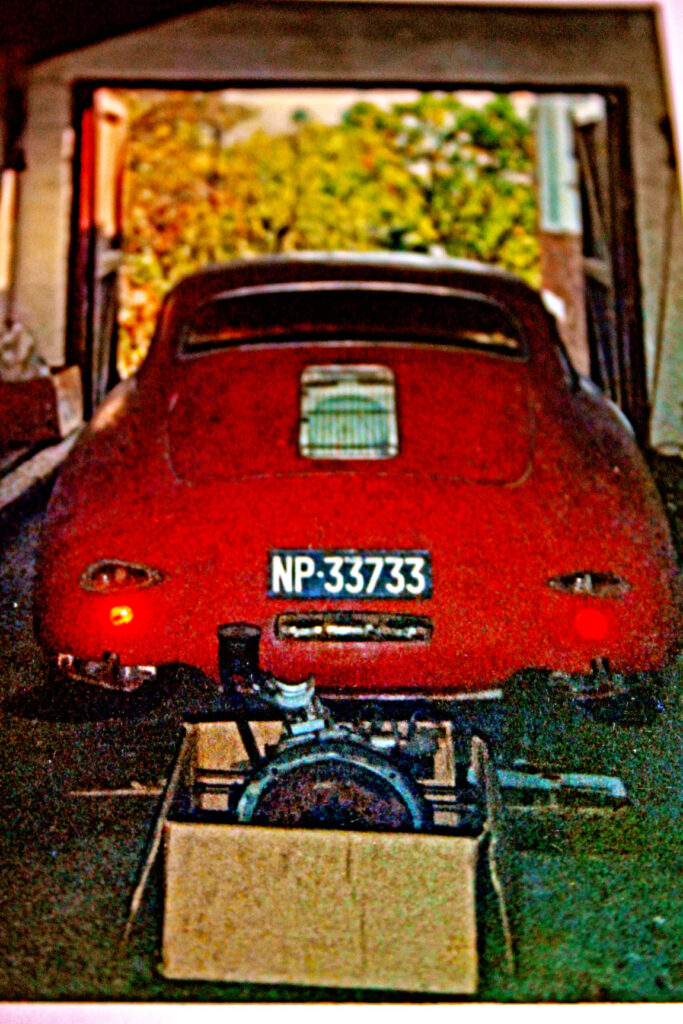
The car under review:
The present owner, ex-rallying colleague and Formula Ford competitor Graham Chilcott, bought this 1958, 356A Type 2 – with 1600 cc “S” motor, one of only two in South Africa and 5990 T2s built that year – from his navigator, Steve Pike. Steve had been the car’s second owner, rallying the car quite aggressively in the Natal (pre-KZN) Midlands during the 1960s. That particular part of its history apparently ended with a front-end collision resulting in wheel, suspension and bodywork damage; along with a seized engine, putting it out of commission.
It remained in storage for many years afterward and, during that time, unused parts stopped working or succumbed to forces of Nature. Others were simply lost or got stolen. Here are some examples:
Theft / Damage: Broken boot lid hinge; battery and cover; inside and outside rear-view mirrors; aerial; radio and speakers; six-volt ivory cigarette lighter; cubby hole base, torn open from underneath; distributor; generator and regulator with wiring cut out.
Mislaid: Inlet manifolds; dip stick; accelerator rod on carburettor pump (R1,500 to replace); all the engine bay heater parts (a further R25,500); two wheels; two luggage strap brackets; rear reflectors and 16 VW front suspension parts during relocation from Pietermaritzburg to Cape Town.
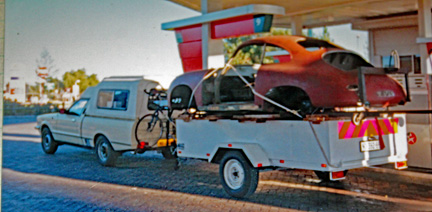
Although Graham had acquired the project in 1990 – having been asked to rebuild it in memory of Steve’s late wife Margie who had navigated for him in the car – career, cycling and pecuniary issues delayed full-time reconstruction until March 2018. By that time he had moved to Pinelands in the Western Cape and built himself suitable garaging and workspace; whilst also designing, building, or where required, buying some necessary equipment.
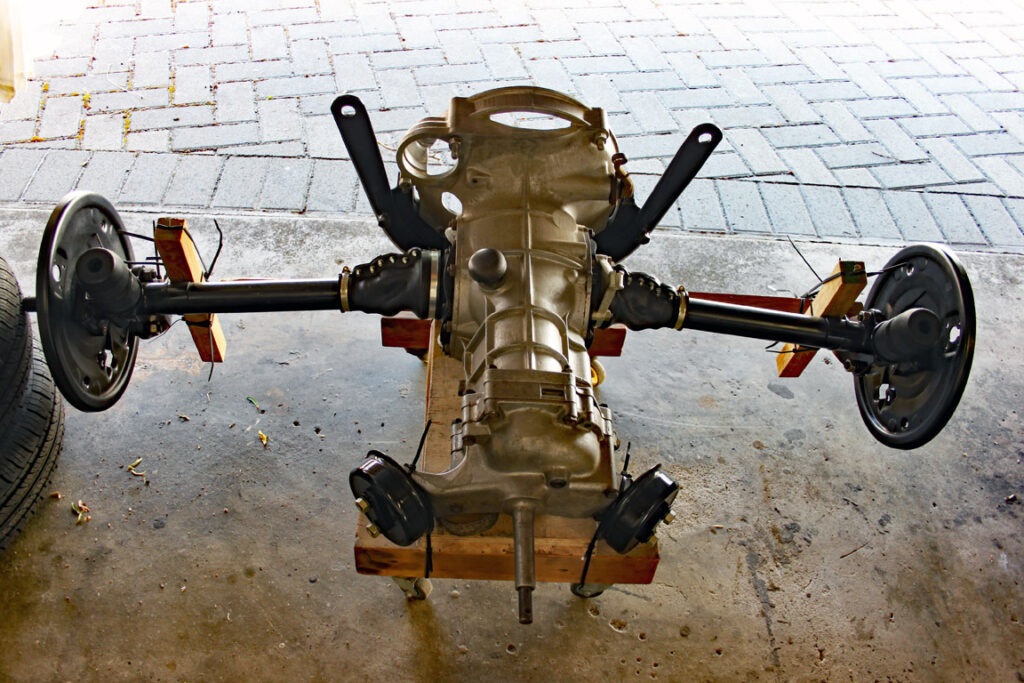
That included a strong wooden pallet bench, glass bead blaster on a mobile rotating stand, multi-rotational engine stand plus wheel adaptor, sound deadening removal chisels, versatile mobile rotisserie, car dolly, engine dolly, trolley jacks and adaptors, versatile drum scaffold, toe-in gauge, headlight alignment board, adaptor for brake drum puller (ex-Renault R8), rear axle nut spanner, 22-ton hydraulic press, mobile assembly and storage workbench, TIG welding setup, trolley for large loaned oxy/acetylene set and a mobile stool. He had, in the meantime, sourced 487 kg of used and damaged spare 356 engine parts from Johannesburg.
Prior to purchase, the car had been metallic silver, then white, then silver again and back to plain 1-mm steel under red PA10 primer. Rust was minimal while the shell was basically sound with only superficial damage.
The aim of the restoration: An affordable classic daily driver – certainly not concours but as close to original as economically possible – with, perhaps, a few minor but reversable upgrades. Graham, being a Govt. Cert. and T4 Dip. Mech. Eng. with broad technical ability and skill sets, used experience gained from an early age through his practical training, hobbies, motorsport and career to tackle another more significant rebuild project.
The process: All PA10 and other material was removed by hand and sander, external bare metal was clear coated for protection and to view problems. Minor rust and dented areas were repaired and a little fibreglass and body filler removed. Then came a day-and-a-half of high-pressure wet glass bead blasting to clean away years-worth of gunk. This was followed, after drying and prepping by zinc-rich priming.
Then followed, in no particular order, TIG-welded replacement of the rear floor pan and battery box base; an additional cover across the centre of the floor pan; comprehensive seam sealing; minimal lead wiping and body filler. That was followed by two coats – two colours – of good quality primer to underside, inside and outside; underbody coating consisting of a first coat brushed inline, a second coat brushed transversally and a stipple-rollered final coat. The interior was treated to a full first base coat throughout; with a clear coat over the dash and black Duco beneath it.
Earlier removal of the original sound deadening material took three months, working part time, to later be replaced by full sheets – rather than original-spec’ pads – and carefully fitted, millimetre by millimetre, with additional material as deemed necessary.
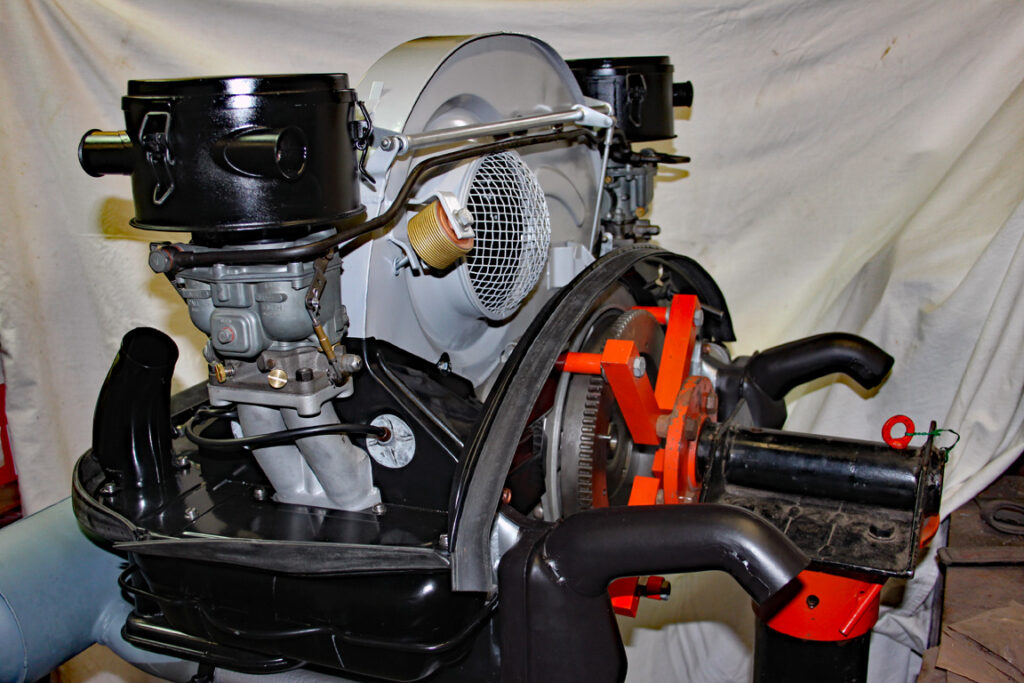
Engine assembly was equally careful: All parts were glass bead blasted, cleaned, checked and stored; new key and missing parts were purchased; tools were made; the relevant book was borrowed and read four times; matched, 90 hp cylinder heads with 40-mm inlets to allow for upgrading from 32 mm Zenith to 40 mm Solex carburettors (in stock for the future) were overhauled with replacement exhaust valve guides; fully balanced professionally; blue-printed ex motorsport experience; carburettors repaired and overhauled; extra inlet manifolds tapered to match cylinder heads; 356 B / C distributor and fuel pump fitted; and a 26-blade VW cooling fan to replace the original 16-blade unit.
Other improvements included an extra metal fuel filter from an Opel, Bosch six-volt competition coil, 180-mm clutch and pressure plate ex a 356B, MGB air filter elements, Bilstein dampers, stainless steel sections in lower door rubber seals and various improved trim fasteners, water resistant plywood foot boards in front, a pair of additional headlight relays, competition-style battery isolator switch / immobiliser, 50 mm2 welding cable for the starter, and three-point safety belts. A working, but 12-volt, radio was installed after building himself a suitable inverter. The wiring harness was extended by 70 mm and replaced at each end with coded wire from the centre section of a loom from another earlier 356 Coupe.
One of Nature’s “interventions” was shrunken carpeting that had to be replaced along with the upholstery. Graham redid and completed about half that work after it had been botched by a so-called professional. Two helpers assisted with some final industrial sewing.
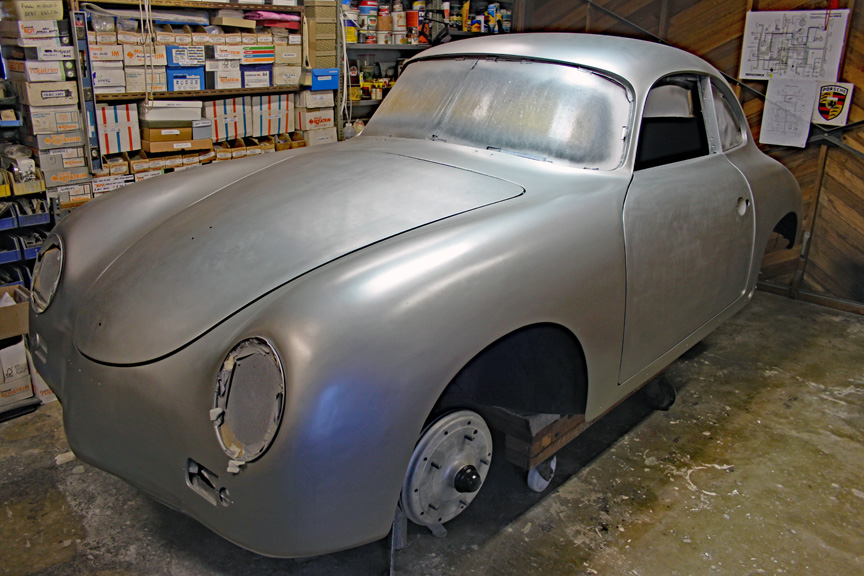
Other work progressed slowly and carefully, culminating in final painting – another project completed with available resources and in-born DIY skills – then re-assembly. The car was completed on 16 June 2021, obtained its COR on 19 July and the final running papers on 19 November of that year. Let’s just say that there was some bureaucratic obstruction along the way and leave it at that?
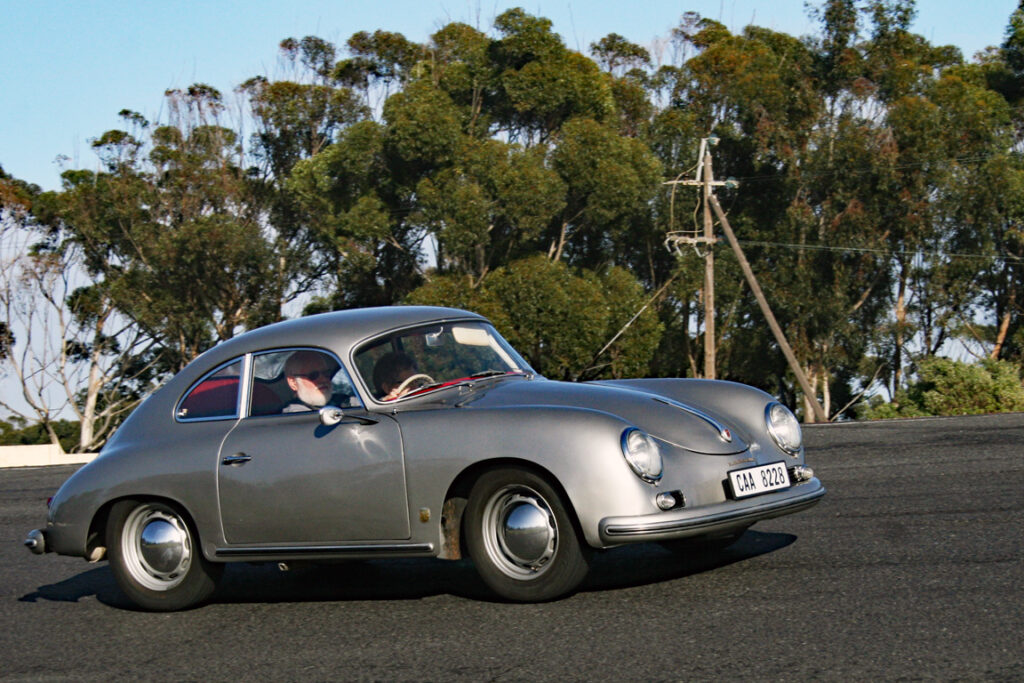
Finally, there are certain immutable Facts of Life: Ferraris are red, Lamborghinis are yellow, hot English cars sport BRG, the best Renaults wear French Racing Blue. And Porsches are born to be silver. Graham’s 356 proudly wears an accurate colour match to its original Silbermetall Code 5706.
Specifications:
Weights
Curb weight (without driver): 850 kg / 1874 lbs
Dry weight: 812 kg / 1790 lbs
Gross vehicle weight rating GVWR: 1200 kg / 2646 lbs
Payload: 350 kg / 772 lbs
Powertrain
Engine manufacturer: Porsche 1600-616/2
Engine type: Spark-ignition 4-stroke
Fuel type: Gasoline (petrol)
Fuel system: Carburettors x 2 twin choke Zenith 32 NDIX
Charge system: Naturally aspirated
Valves per cylinder: 2
Cylinders, alignment: Boxer 4 OHV
Displacement: 1582 cc / 96.6 cui
Bore: 82.5 mm / 3.25 in
Stroke: 74 mm / 2.91 in
Compression ratio: 8.5 : 1
Horsepower net: 55 kW / 75 PS / 74 hp (DIN)/ 5000 rpm
Torque net: 117 Nm / 86 ft-lb / 3700 rpm
Horsepower gross: 65 kW / 88 PS / 87 hp (SAE) / 5000 rpm
Redline: 4500 to 5000 rpm
Car power to weight ratio net: 64.7 watt/kg / 29.4 watt/lb
Car power to weight ratio gross: 76 watt/kg / 35 watt/lb
Car weight to power ratio net: 15.5 kg/kW / 11.3 kg/PS / 25.3 lbs/hp
Car weight to power ratio gross: 13.1 kg/kW / 9.7 kg/PS / 21.5 lbs/hp
Fuel capacity: 52 litres / 13.7 U.S. gal / 11.4 imp. gal
Engine lubricant oil capacity: 5 litres / 5.3 U.S. qt / 4.4 imp. Qt with filter change
Battery capacity: 84 Ah 6V
Transmission: 4 speed synchromesh plus reverse
Dimensions and capacities
Length: 3950 mm / 155.5 in
Width: 1670 mm / 65.7 in
Height: 1310 mm / 51.6 in
Wheelbase: 2100 mm / 82.7 in
Front track: 1306 mm / 51.4 in
Rear track: 1272 mm / 50.1 in
Ground clearance: 160 mm / 6.3 in
Turning circle between walls: 11 m / 36.1 ft
Turning circle between kerbs: 10.3 m / 33.8 ft
Drag coefficient Cd estimated: 0.32
Frontal area A estimated: 1.82 m2
Acceleration:
0-100 km/h (s): 13.1
0-160 km/h (s): 47.8
0-60 mph (s): 12.3
0-100 mph (s): 48.9
Top speed: 174 km/h
Drag times:
Standing 1/4mile (s): 18.7
Speed at 1/4mile: 120 km/h / 75 mph
Standing km (s): 34.3
Details:
- Most cars were Normal 1600cc / 60hp (Damen / Dames / Ladies) CR 7,5:1
- Earlier 1600S or Super was 75 hp with high lift cam, CR 8,5:1
Alternative: 8,5:1 with 40 mm Solex carbs giving > 109mph / 175kph - 50 percent of all cars went to USA
- 40 percent of those went to California
- Estimated that some 50 percent of all 356s ever made are still around
- Throttle linkage is all rods and bell cranks while RHDs are more complex
- 400 and 300 Hz hooters had optional steering ring, central button became headlight flasher
- Battery cable 3000 mm
- Rev counter cable 4000 mm
- Sound deadening 33 kg
- Door mass 45 kg pair
- Bumpers mass 15 kg per pair
- Window frames are heavy solid brass sections
END
Views: 12