Category: Site page

  • 1930 Ford Model A Sport Coupe

    Growing up with a Model A, by Mike Leisegang
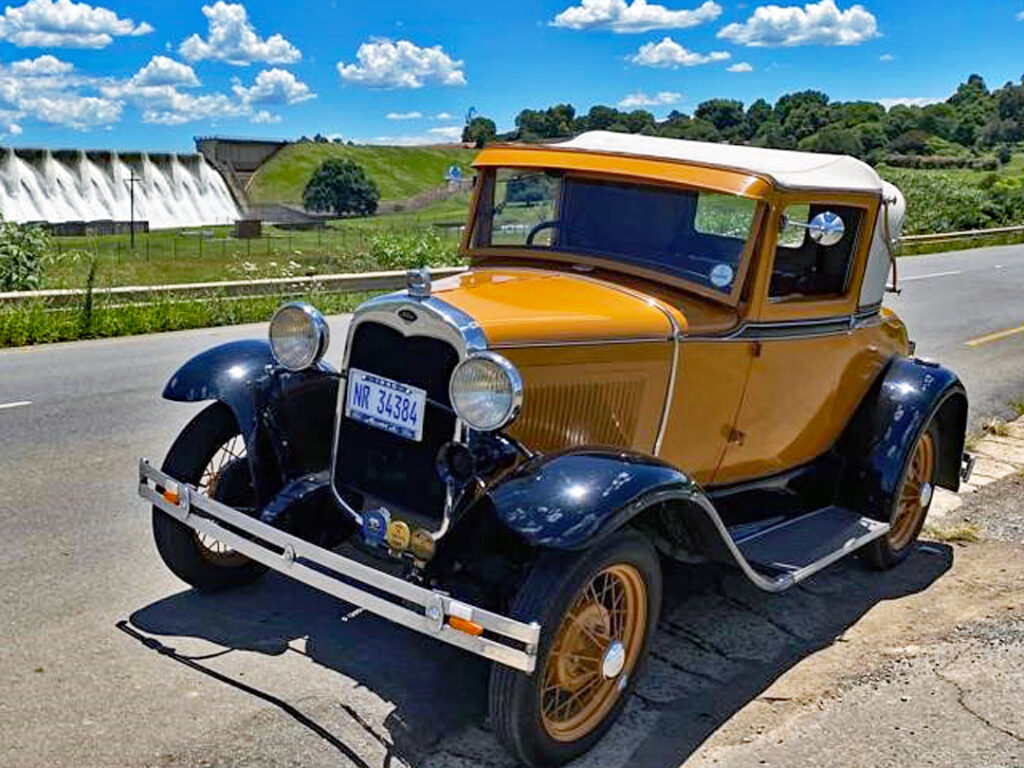
    The author’s pride and joy parked across the way from Midmar Dam

    As a child, of about seven, I rode in this car when it belonged to my father’s cousin in Bedfordview.

    It had been bought new by an old man in Kensington (Johannesburg) and, when he passed away, his son dismantled the car with the idea of making a hotrod out of it. The project thankfully never took off. The car was subsequently found by a Mr Henry Bessinger who rescued it and brought it to his home in Bedfordview. My dad’s cousin Gordon Stewart, an avid Ford fanatic, while attending a children’s birthday party at Mr Bessinger’s house, saw the car in pieces in the garage and bought it. It was rebuilt to its current state sometime in the 1970s.

    Gordon kept the car in a special spot in his garage, and it was only taken out on very special occasions. Getting it out of the garage meant moving many Ford Cortinas, Ford 20Ms and so on. He eventually retired and moved to Howick, taking the car with him. It again stood in a spot, the one farthest from the garage door, where the petrol tank corroded to a point at which the car was undriveable. It remained like that for 15 years until Gordon decided to sell it in 2012 on, of all unfortunately named places, “Junkmail”. I couldn’t let that happen so, in order to keep it in the family, I immediately approached him to arrange a deal.
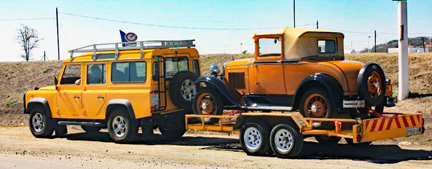
    We trailered the Model A from Howick and, once in Randburg, began stripping the fuel tank out. Silverton Radiators in Eloff Street did a marvellous job of cleaning the tank up. In the meantime my wife and I were frantically trying to find out more about motor car mechanics, those knowledgeable about Model As in particular, so that we could get the engine running. We learned a lot from the Internet and managed, eventually, to fire it up.

    We subsequently discovered that there are many more Model As remaining in existence than we initially thought and, during 2013, the Model A Club of South Africa was formed. Within six years this nation-wide club grew to over 100 members – representing around 200 cars – making it, at the time, the biggest single-model club affiliated to the South African Vintage and Veteran Association (SAVVA).
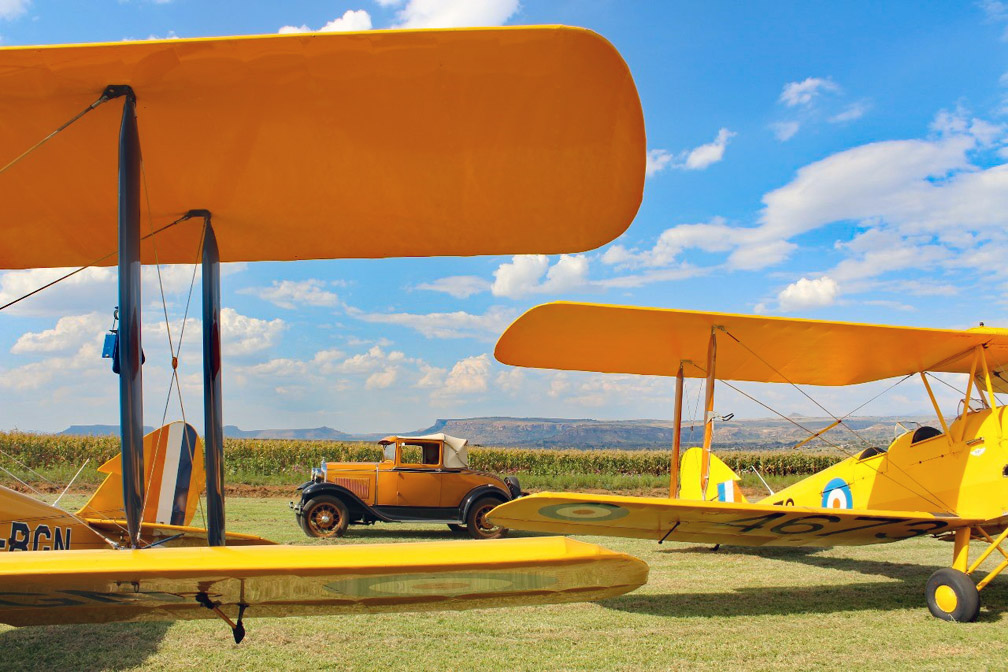
    Visiting old friends

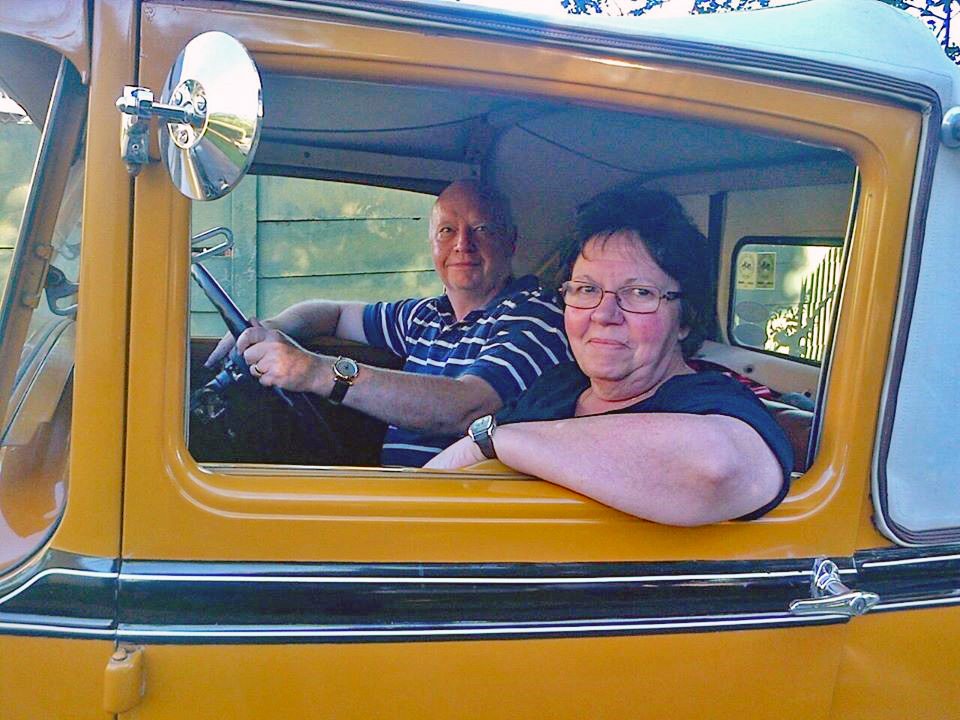
    Our trusty old Model A became known as ‘Betsy’ and she has given us endless fun and enjoyment. She is driven regularly and I often used to take her to work! Betsy has motored from Johannesburg to KZN twice, without a moment’s trouble, and we have been able to share her with Gordon Stewart whenever we visited him.
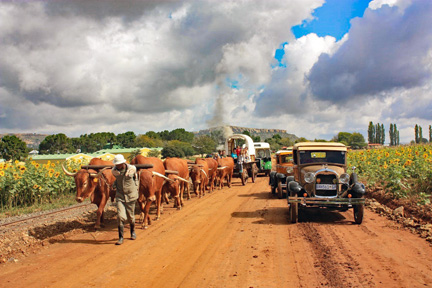
    She has also visited the Sandstone Heritage Trust museum near Ficksburg twice:
    https://museumexplorer.co.za/sandstone-heritage-museum/
    https://www.sandstone-estates.com/

    What a pleasure and joy to drive; and a completely different way to see our beautiful country! Betsy now lives in Howick and is often seen driving around town.
    For those who “have to know”, here are some technical details:

    Ford Model A 1928 – 1931

    How did the Model A come about? It was derived from the Lincoln – and was affectionately called a “Baby Lincoln” – because Edsel Ford ran said motor company until his father brought him in, to help the ailing Ford company, when Model T sales were dropping in 1926/7.
    Where was it made? There were 35 production plants in the USA. Cars destined for South Africa, and other Commonwealth countries, were produced in Windsor, Canada. Ford manufactured Model As in the United States, Canada, France, Germany and England. There were assembly plants in Australia, South Africa, Argentina, Chile, Japan, Denmark, Ireland, and Russia.
    When was it made? 1928 (late 1927) – 1931
    How many were made?
    Around 4 ½ to 5 million. It took VW’s Beetle much longer to reach such numbers by the way.
    How many are in South Africa?
    Over 350; about half of which are running.
    How much did it cost when new? $455 to $795
    What are they worth now? In running, drivable condition, about R250 000 and upwards
    How much does it weigh? 2,255 pounds, or 1,023 Kilograms
    Where was the engine? In the front
    What size is the engine ? 3,286 cc / 200.5 cu in. / 3.3 litre four-cylinder
    How powerful is the engine? 40 HP (29.44 KW) @ 2,206 RPM
    What about the gearbox? Manual: Three forward speeds, one reverse
    What is the fuel consumption? Between 25 and 30 mpg (US), 8 to 12 km/l or 12.5 to 8.3 l/100 km. Those are official figures. South African owners of the time, who kept meticulous records, state that the best they ever achieved was 19 mpg Imperial or about 16 mpg US.
    Front or rear wheel drive? Rear-wheel drive
    How fast can it go? Top speed is around 65 mph (104 km/h). Official figure again; owners say that its top speed was more like 50 mph – unless one freewheeled downhill in order to save fuel.
    How does it stop? Four-wheel mechanical drum brakes (300 working parts when the brake pedal is pressed).
    Where is the petrol tank? In front of the windscreen – fuel is gravity-fed to the carburettor
    How big is the petrol tank? 1928/29: 10 US gallons / 38 litres; 1930/31: 11 US gallons / 41 litres
    How far can you go on a tank of fuel? About 250 km
    How long is it? 103.5 inches, or 2.62 metres
    Can you still get parts? Almost everything is still available; mostly from US suppliers
    What about tyres? Tyre sizes: 1928 – 1929, 440/450 x 21. 1930-on, 475/500 x 19.
    Recommended inflation pressure: 35 psi = about 2.4 bar.
    Tyres have to be imported from the USA

    Some fun facts: The Model A

    1. Had higher annual production figures (1.2 million per year) than the Model T (773,000 per year).
    2. Was the first Ford to use the standard set of driver controls with conventional clutch and brake pedals, throttle and gearshift.
    3. Was the first Ford to wear the famous Blue Oval radiator badge as we know it today.
    4. Canadian Model A Fords had black radiator badges
    5. Was the first car to have safety glass
    6. Model As have been to the South Pole.
    7. Model A engines have been used to power aeroplanes
    8. The Soviet Union company GAZ, that started as a cooperation between Ford and the Soviet Union, made a licensed version of the Model A from 1932-36.
    9. Rarest Model A is the 1931 Town Car Delivery

    Views: 14
  • MOBY DICK – an encounter with a Great White Whale

    This article, written just over 21 years ago by a friend who is no longer with us, tells the tale of how he borrowed another bride-car chauffeur’s wedding chariot because his own was VOR (vehicle off road) at the time.

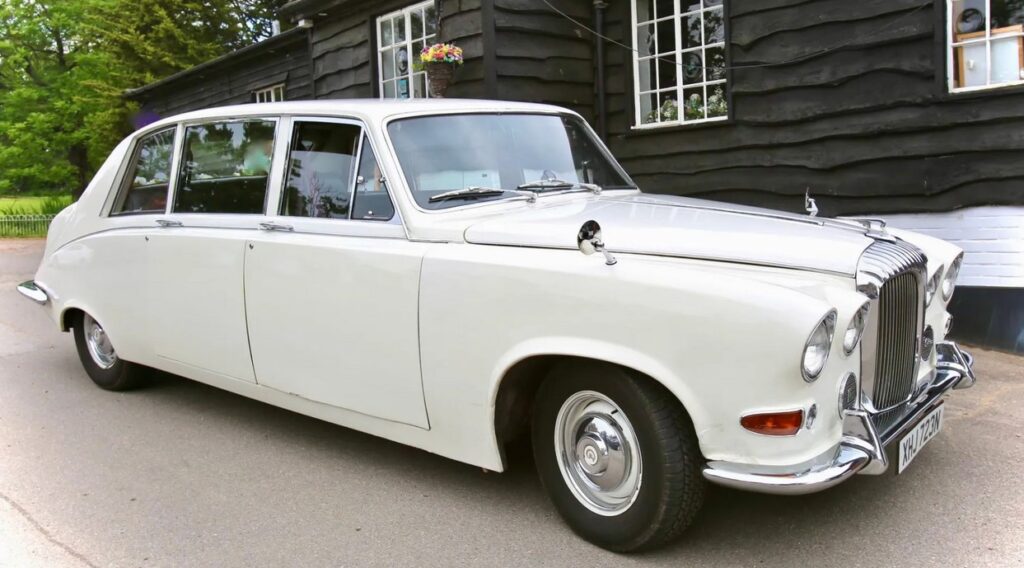
    Let us be clear, at the outset, that this piece is nothing other than flattering, but when the owner of a car is called Melville and the car in question is white, 5.7m long and 1.97m wide, what can spring to mind other than that epic tale of mammalian marine life?

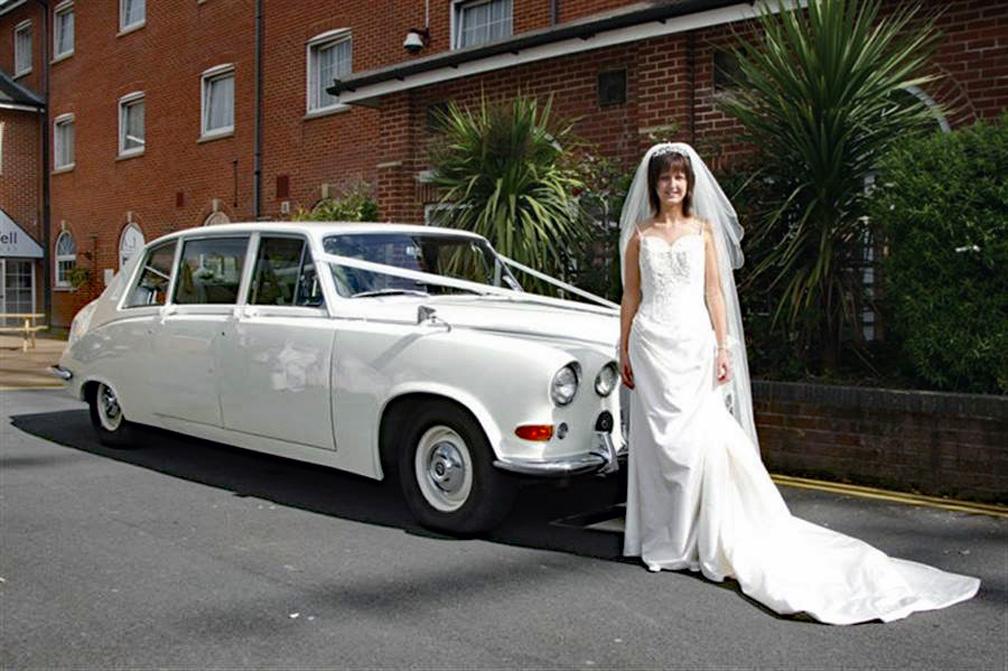
    The story starts back in September when a bride-to-be, planning her wedding, called around to view Hortense my Daimler One-O-Four Auto. Although effusive in her praise of Hortense’s styling, presence and general understated elegance, there was one problem. The car is green, Balmoral Green admittedly, but green nevertheless. This good lady never sets foot in green cars, and would certainly not be travelling to her wedding in a green car.

    However, as she was about to leave, she spotted Lydia my S-Class Mercedes which, apart from being commodious, is white – a colour often associated with weddings and, in the eyes of the impending bride, a lucky colour.

    This turned out to be a mistake as, to cut a long story short, Lydia was unexpectedly detained – mere hours before the wedding – at Garden City Motors waiting for a part to be sent out from Sindlefingen, and was therefore temporarily unavailable. And so it was that I turned to Colin Melville, owner of another Daimler, the later model DS 420, who at one-hour’s notice kindly offered to loan his car to me.

    In the first paragraph we have already considered some of the Daimler DS 420 statistics, but here are some more: The car weighs in excess of 42 cwt ( 2 139kg ), has a floor pan 20 ins longer than a Mark X Jaguar and is a genuine 7/8-seater. A more than adequate top speed of 115 mph (184 km/h) and acceleration of 0-100 km/h in 12 seconds was, and still is, quite excellent. On the market between 1968 and 1995 it proved to be one of Jaguar-Daimlers longest-lived marques.

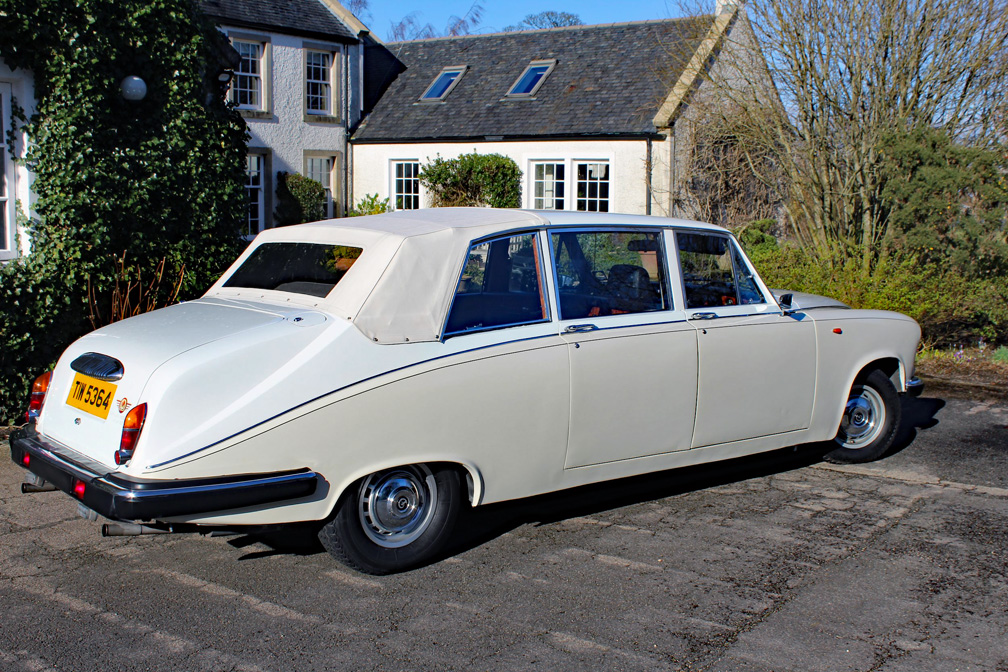
    Styled by the old master, William Lyons, there are strong cues derived from the Hooper coach-built Empress line, sweeping lines, hooded headlights all reminiscent of the mid-fifties Docker days. This gives the car phenomenal elegance despite its sheer bulk, although to my mind white is probably the least flattering colour for these limousines.

    Colin’s car was built by Vanden Plas in London – later cars were built in Coventry – and still sports the flying “D” above the radiator grille. These were later banned in the interests of safety although no one can supply me with any figures on how many people were actually killed by flying Ds. It has a fascinating history, employed as it was in the carriage trade for 30 years. The list of people who have travelled in the back is extensive and impressive.

    So what was it like to drive such a car? At the end of a day that saw two return trips from Howick to Nottingham Road on the Old Road, and some VERY tight manoeuvring outside Lysna Mallard guest house, I admit to have been exhausted. This was partly due to the nervous tension of driving someone else’s huge car at someone else’s wedding, and partly due to the driving position of the car.

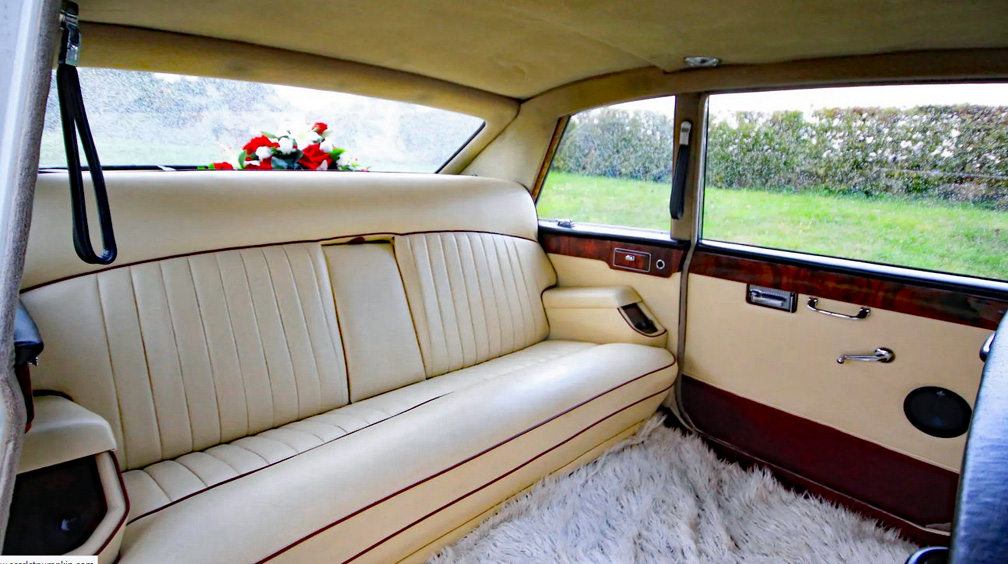
    Passengers in the back were able to spread out in comfort, and I was able to seal them off. At the touch of a button the glass partition between the driver and the passengers sweeps shut. However this is a limousine and the driver comes last. Every limousine I have ever driven, admittedly only four, has had appalling driver space. You sit tight up against the steering wheel with your knees on backwards to press pedals that seem to be tucked away high under the dash.

    The power train is pure Jaguar Mark X/420G although the 4.2-ltr XK engine in this case has twin, not triple, carburettors producing only 245 bhp. The front and rear suspension is of Bob Knight design and exudes the usual Jaguar artistry. The big limousine has phenomenal road holding and handling with a smoothness that is still impressive and enjoyable 30 years later. Impressive also were the brakes – discs all around naturally. Despite the cramped driver space I must admit to have enjoyed the experience. The car cannot be described as nimble, but it is surprisingly agile in the manner of a sumo wrestler dressed in a well-cut suit.

    But is it really a Daimler? Well yes and no. It has many Daimler characteristics, that of huge size, understated elegance (at least when compared with current limousines or indeed the Crewe product) It has striking styling from most angles, clearly derived from Daimler DNA, and it has four-wheel disc brakes – a Daimler characteristic on all models from 1958 – and of course automatic transmission (Daimler dumped conventional gearboxes in 1931). Critics will point to the XK engine and point out that the Turner designed 4.5-ltr V8 should have been used. This is correct, but this XK engine has been set up to provide huge gobs of refined low-end torque (I never needed more than 2 500 rpm the whole day) which is a strong Daimler characteristic.

    Perhaps the most compelling evidence to suggest that Sir William Lyons and the lads at Jag understood the Daimler approach was the way in which the Bride, wearing an impossible dress, managed to get through the door and into the back seat. Statically chic, the dress was about five feet wide at the base and needed three people to move it. Can you imagine getting that through the back door of a Mark 2?

    WJ Quigley

    Some technical stuff:

    Powertrain

    Engine manufacturer:

    Jaguar XK6 4.2-Litre

    Engine type: spark-ignition 4-stroke

    Fuel type: gasoline (petrol)

    Fuel system: 2 carburettors

    Dimensions & capacities

    Length: 5740 mm / 226 in

    Width: 1968 mm / 77.5 in

    Height: 1619 mm / 63.75 in

    Wheelbase: 3581 mm / 141 in

    Front track: 1473 mm / 58 in

    Rear track: 1473 mm / 58 in

    Ground clearance: 177 mm / 7 in

    Turning circle btw. kerbs: 14.02 m / 46 ft

    Drag coefficient Cd estimated by a-c: 0.44

    Frontal area A estimated by a-c: 2.64 m2

    Drag area CdA estimated by a-c: 1.164 m2

    Charge system: naturally aspirated

    Valves per cylinder: 2

    DOHC

    Cylinders alignment: Line 6

    Displacement: 4235 cm3 / 257.5 cui

    Bore: 92.07 mm / 3.62 in

    Stroke: 106 mm / 4.17 in

    Compression ratio: 7.5 : 1

    Horsepower net: 123 kW / 167 PS / 165 hp (DIN)/ 4250 rpm

    Torque net: 312 Nm / 230 ft-lb/ 3000 rpm

    Gearbox: Borg Warner BW 12

    Transmission type: automatic

    Number of gears: 3

    Traction: RWD (rear-wheel drive)

    Final drive ratio std: 3.54

    Standard tyres: 205/70 HR 15

    Top speed: 177 km/h / 110 mph

    Acceleration:
    0-100 km/h (s): 14.8
    0-160 km/h (s): 53.1
    0-60 mph (s): 14.0
    0-100 mph (s): 54.4

    Kerb weight (without a driver): 2210 kg / 4872 lbs

    Dry weight: 2133 kg / 4702 lbs

    Views: 6

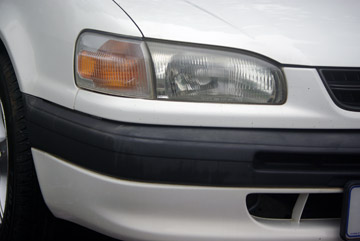
  • 1998 Toyota Corolla 1.3 GLE

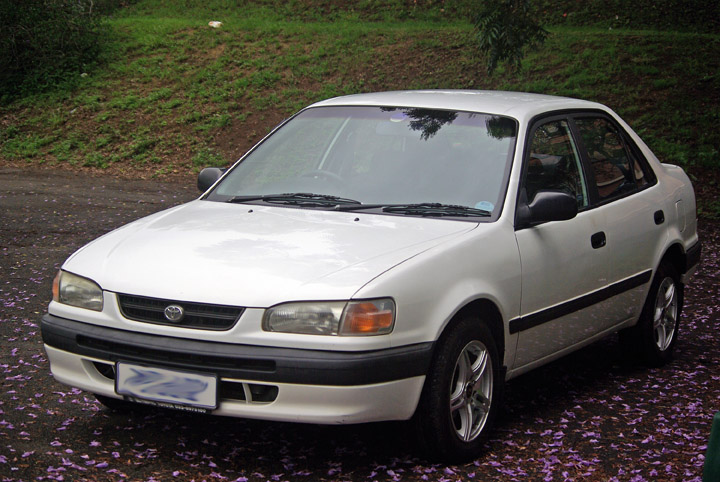
    !998 Toyota Corolla review

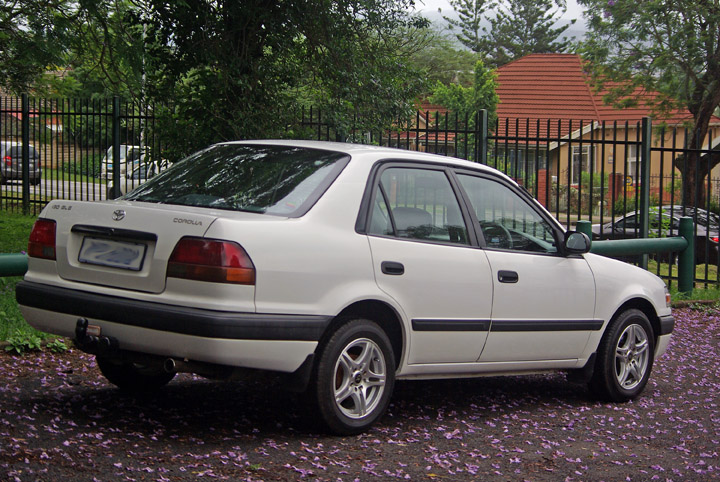
    Twenty-plus: 1998 Toyota Corolla 130 GLE (E-110)

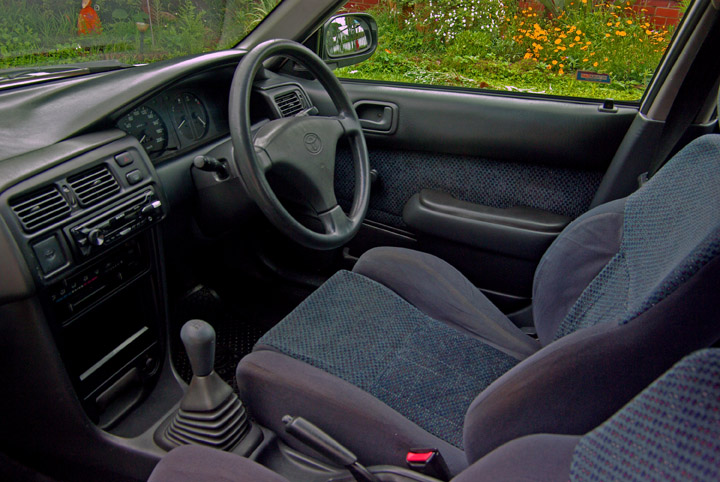
    The radio/CD player is an after-market item.
    The alloy wheels are after-market accessories


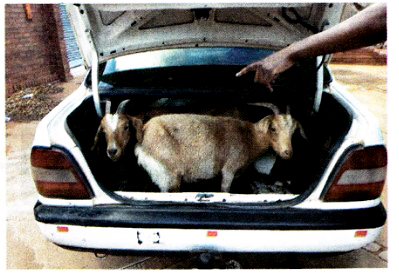
    As this clipping from a January, 2020 newspaper shows, the boots of Corollas like mine (this one belonged to a stock thief) can hold two small goats.

    Views: 23

  • Home Page

    https://oldcars.net.za/blog/2024/12/24/british-cars/

    https://oldcars.net.za/blog/2024/12/26/european-cars

    https://oldcars.net.za/blog2024/12/27/cars-from-north-america

    https://oldcars.net.za/blog2024/12/27/cars-from-elsewhere/

    https://oldcars.net.za/work-zone/

    Comments, queries or want to tell us about your own cars?

    email us on: admin@oldcars.net.za

    Tell us about your old car and include some hi-res pics. Don’t worry if you’re “not a writer”. Give us the bare details and we’ll write it up for you.

    Views: 9