This article, written just over 21 years ago by a friend who is no longer with us, tells the tale of how he borrowed another bride-car chauffeur’s wedding chariot because his own was VOR (vehicle off road) at the time.
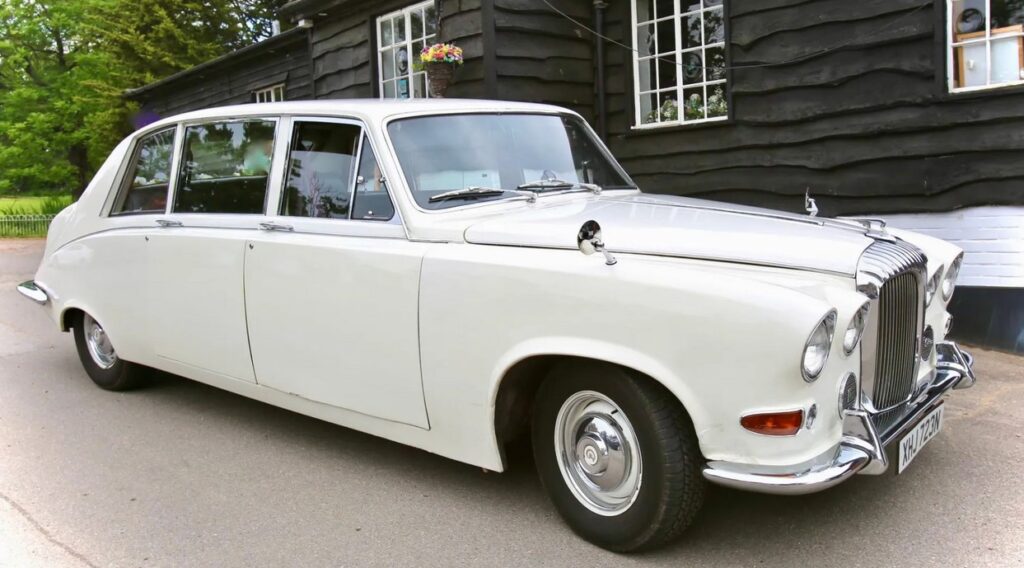
Let us be clear, at the outset, that this piece is nothing other than flattering, but when the owner of a car is called Melville and the car in question is white, 5.7m long and 1.97m wide, what can spring to mind other than that epic tale of mammalian marine life?
The story starts back in September when a bride-to-be, planning her wedding, called around to view Hortense my Daimler One-O-Four Auto. Although effusive in her praise of Hortense’s styling, presence and general understated elegance, there was one problem. The car is green, Balmoral Green admittedly, but green nevertheless. This good lady never sets foot in green cars, and would certainly not be travelling to her wedding in a green car.
However, as she was about to leave, she spotted Lydia my S-Class Mercedes which, apart from being commodious, is white – a colour often associated with weddings and, in the eyes of the impending bride, a lucky colour.
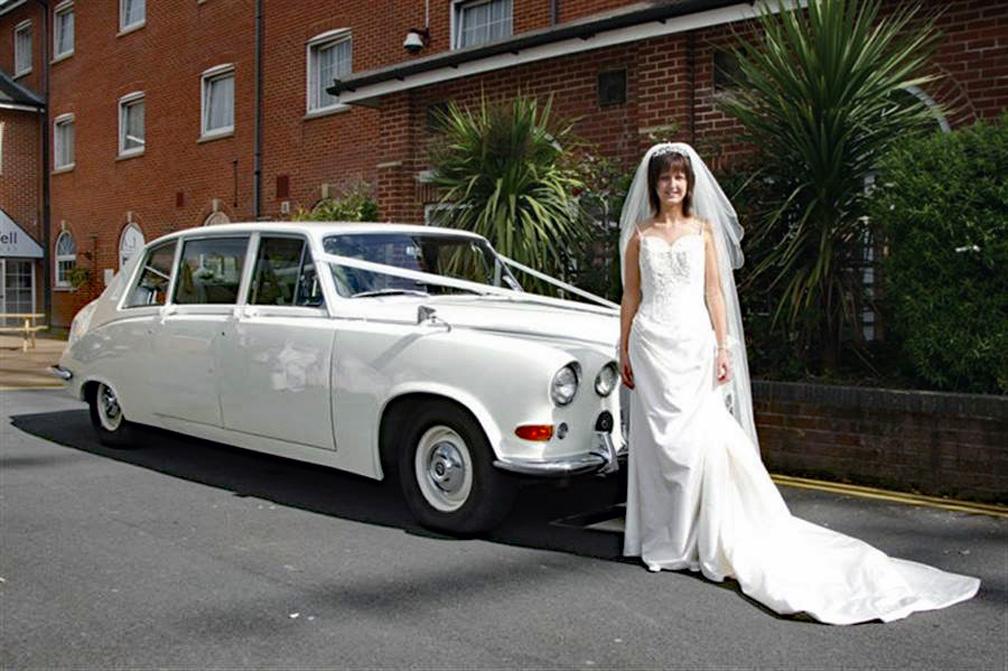
This turned out to be a mistake as, to cut a long story short, Lydia was unexpectedly detained – mere hours before the wedding – at Garden City Motors waiting for a part to be sent out from Sindlefingen, and was therefore temporarily unavailable. And so it was that I turned to Colin Melville, owner of another Daimler, the later model DS 420, who at one-hour’s notice kindly offered to loan his car to me.
In the first paragraph we have already considered some of the Daimler DS 420 statistics, but here are some more: The car weighs in excess of 42 cwt ( 2 139kg ), has a floor pan 20 ins longer than a Mark X Jaguar and is a genuine 7/8-seater. A more than adequate top speed of 115 mph (184 km/h) and acceleration of 0-100 km/h in 12 seconds was, and still is, quite excellent. On the market between 1968 and 1995 it proved to be one of Jaguar-Daimlers longest-lived marques.
Styled by the old master, William Lyons, there are strong cues derived from the Hooper coach-built Empress line, sweeping lines, hooded headlights all reminiscent of the mid-fifties Docker days. This gives the car phenomenal elegance despite its sheer bulk, although to my mind white is probably the least flattering colour for these limousines.
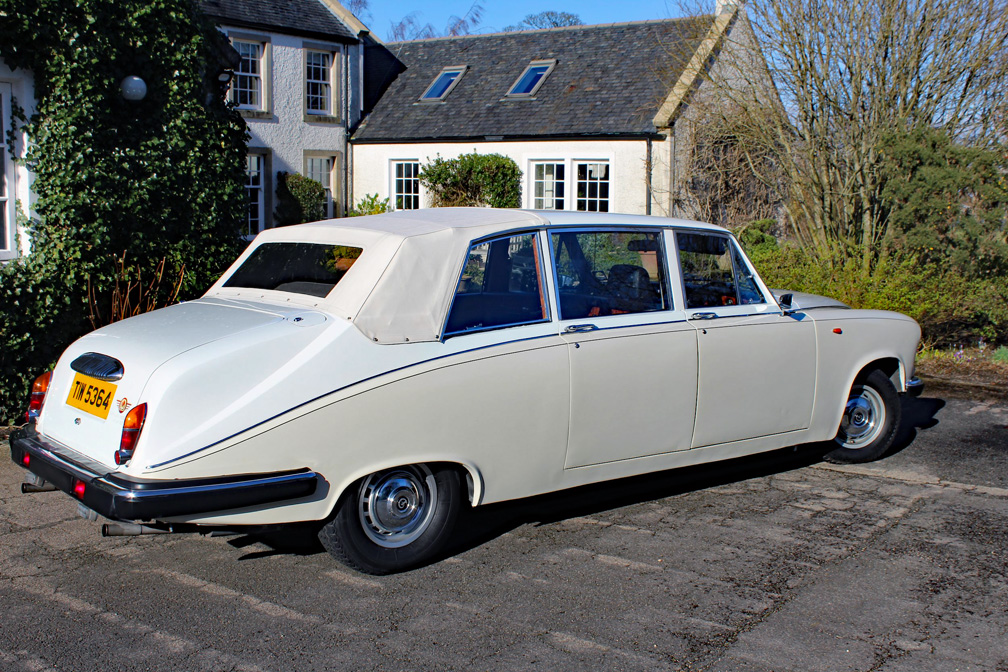
Colin’s car was built by Vanden Plas in London – later cars were built in Coventry – and still sports the flying “D” above the radiator grille. These were later banned in the interests of safety although no one can supply me with any figures on how many people were actually killed by flying Ds. It has a fascinating history, employed as it was in the carriage trade for 30 years. The list of people who have travelled in the back is extensive and impressive.
So what was it like to drive such a car? At the end of a day that saw two return trips from Howick to Nottingham Road on the Old Road, and some VERY tight manoeuvring outside Lysna Mallard guest house, I admit to have been exhausted. This was partly due to the nervous tension of driving someone else’s huge car at someone else’s wedding, and partly due to the driving position of the car.
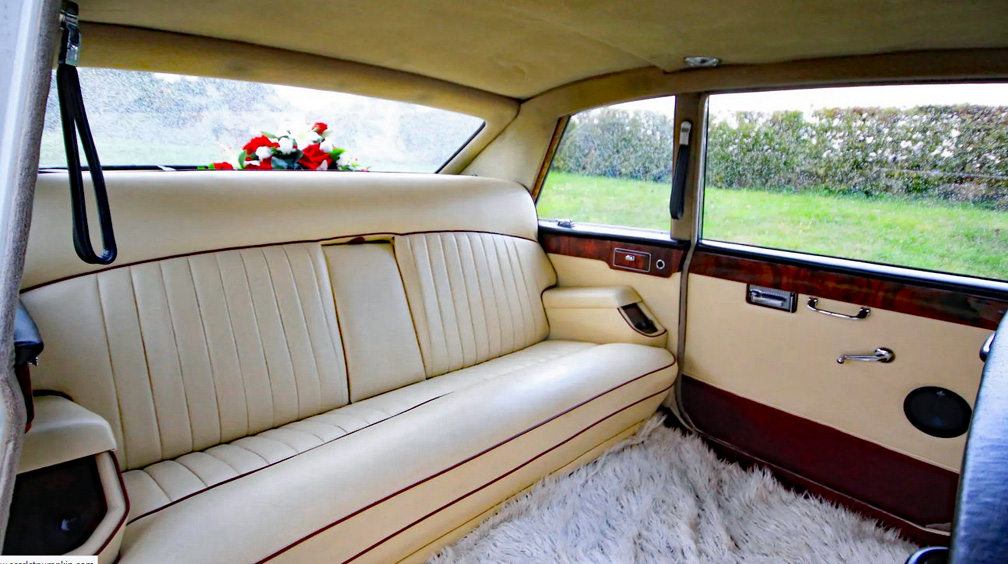
Passengers in the back were able to spread out in comfort, and I was able to seal them off. At the touch of a button the glass partition between the driver and the passengers sweeps shut. However this is a limousine and the driver comes last. Every limousine I have ever driven, admittedly only four, has had appalling driver space. You sit tight up against the steering wheel with your knees on backwards to press pedals that seem to be tucked away high under the dash.
The power train is pure Jaguar Mark X/420G although the 4.2-ltr XK engine in this case has twin, not triple, carburettors producing only 245 bhp. The front and rear suspension is of Bob Knight design and exudes the usual Jaguar artistry. The big limousine has phenomenal road holding and handling with a smoothness that is still impressive and enjoyable 30 years later. Impressive also were the brakes – discs all around naturally. Despite the cramped driver space I must admit to have enjoyed the experience. The car cannot be described as nimble, but it is surprisingly agile in the manner of a sumo wrestler dressed in a well-cut suit.
But is it really a Daimler? Well yes and no. It has many Daimler characteristics, that of huge size, understated elegance (at least when compared with current limousines or indeed the Crewe product) It has striking styling from most angles, clearly derived from Daimler DNA, and it has four-wheel disc brakes – a Daimler characteristic on all models from 1958 – and of course automatic transmission (Daimler dumped conventional gearboxes in 1931). Critics will point to the XK engine and point out that the Turner designed 4.5-ltr V8 should have been used. This is correct, but this XK engine has been set up to provide huge gobs of refined low-end torque (I never needed more than 2 500 rpm the whole day) which is a strong Daimler characteristic.
Perhaps the most compelling evidence to suggest that Sir William Lyons and the lads at Jag understood the Daimler approach was the way in which the Bride, wearing an impossible dress, managed to get through the door and into the back seat. Statically chic, the dress was about five feet wide at the base and needed three people to move it. Can you imagine getting that through the back door of a Mark 2?
WJ Quigley
Some technical stuff:
Powertrain
Engine manufacturer:
Jaguar XK6 4.2-Litre
Engine type: spark-ignition 4-stroke
Fuel type: gasoline (petrol)
Fuel system: 2 carburettors
Dimensions & capacities
Length: 5740 mm / 226 in
Width: 1968 mm / 77.5 in
Height: 1619 mm / 63.75 in
Wheelbase: 3581 mm / 141 in
Front track: 1473 mm / 58 in
Rear track: 1473 mm / 58 in
Ground clearance: 177 mm / 7 in
Turning circle btw. kerbs: 14.02 m / 46 ft
Drag coefficient Cd estimated by a-c: 0.44
Frontal area A estimated by a-c: 2.64 m2
Drag area CdA estimated by a-c: 1.164 m2
Charge system: naturally aspirated
Valves per cylinder: 2
DOHC
Cylinders alignment: Line 6
Displacement: 4235 cm3 / 257.5 cui
Bore: 92.07 mm / 3.62 in
Stroke: 106 mm / 4.17 in
Compression ratio: 7.5 : 1
Horsepower net: 123 kW / 167 PS / 165 hp (DIN)/ 4250 rpm
Torque net: 312 Nm / 230 ft-lb/ 3000 rpm
Gearbox: Borg Warner BW 12
Transmission type: automatic
Number of gears: 3
Traction: RWD (rear-wheel drive)
Final drive ratio std: 3.54
Standard tyres: 205/70 HR 15
Top speed: 177 km/h / 110 mph
Acceleration:
0-100 km/h (s): 14.8
0-160 km/h (s): 53.1
0-60 mph (s): 14.0
0-100 mph (s): 54.4
Kerb weight (without a driver): 2210 kg / 4872 lbs
Dry weight: 2133 kg / 4702 lbs
Views: 6
Leave a Reply